We all have things that come naturally to us and things that don’t. Some people find it easy to speak up, while others prefer to stay quiet. Some are natural caregivers,
while others are more comfortable taking charge. But sometimes, doing the right thing means going beyond what feels natural.
This week’s Torah portion introduces us to Abraham, whose life was defined by kindness and hospitality. Yet when he learned that G-d intended to destroy Sodom, Abraham did something unexpected. He challenged the divine plan and pleaded for the lives of its inhabitants.
Abraham was known for his kindness, not confrontation. But when lives were at stake, he stepped beyond his natural tendencies because he recognized the gravity and the need of the moment.
This is a lesson for all of us. Our natural qualities are gifts, but they don’t define the limits of what we can accomplish. Sometimes standing up for what is right means doing something that makes us uncomfortable.
Judaism teaches that growth happens when we push beyond our familiar habits and instincts. We have to be willing to become more than we already are.
May we learn from Abraham’s example to recognize those moments when we are called to rise above ourselves and bring more goodness into the world. Every time we go beyond our nature to do what is right, we bring ourselves
and the world one step closer to the coming of Moshiach, when goodness and G-dliness will fill the world.
Shabbat shalom,
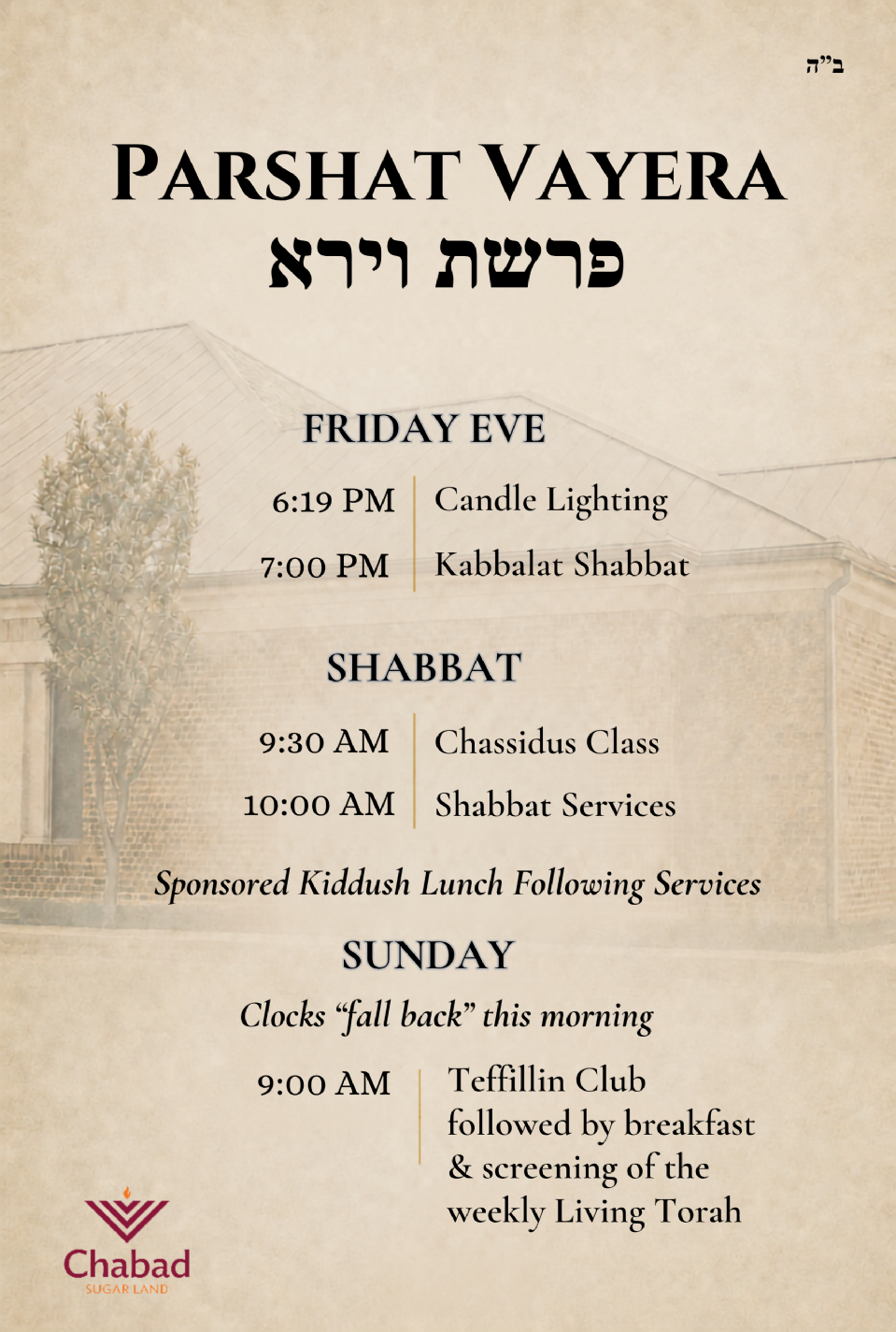
Service Times:
Sugar Land Jewish Women's Circle Series Debut
What if the stories of Genesis could help us better understand our own lives?
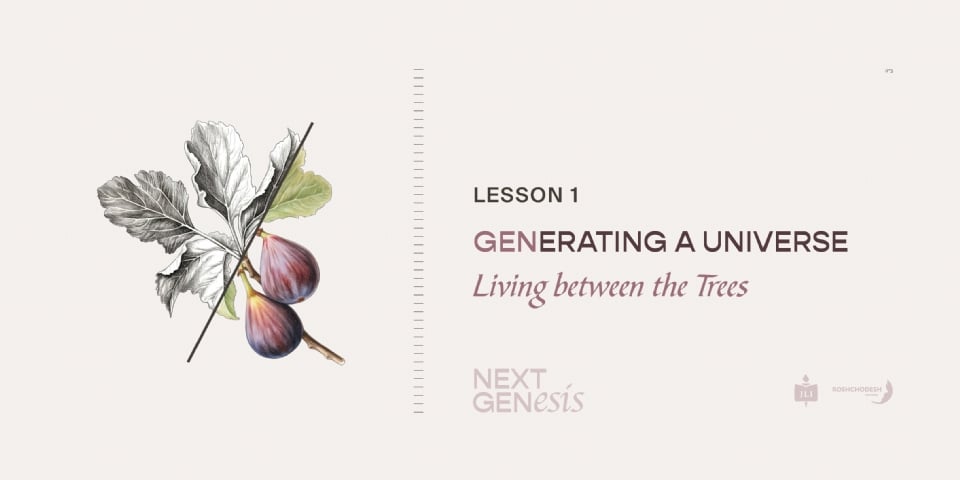
Join the Sugar Land Jewish Women's Circle for NEXT GENesis, a new seven-part course exploring the timeless stories of Genesis and the meaningful lessons they hold for our everyday lives, relationships, and personal growth.
The first women's circle gathering is Thu. November 5th, at 7:00 PM. All Jewish women warmly welcome!
Please Click here to view the invitation. Advance RSVP appreciated.
Click here for the Weekly Encounter with the Rebbe story!
Weekly Parsha Video
Parshat Vayera:
How to nourish the soul.
Pasta & Parsha is here!
First Pasta & Parsha Wednesday, Nov. 4th!
“When Is Your Birthday?”
The idea of marking one’s birthday as a time of celebration, reflection, and thanksgiving is relatively new in Jewish history.
So when the Rebbe began to introduce the Jewish birthday campaign, many people were not even sure of the exact date of their Jewish birthday.
A visitor from Israel, Reb Avraham Dunin (1937-2011), once attended a private audience for his birthday. In his note, he asked for a blessing for his birthday, which would take place on Cheshvan 6. The Rebbe read through the note and wondered aloud “Vov? Zayin? [six? seven?]”
The Rebbe concluded the meeting with a blessing, and as Reb Avraham left the room, the Rebbe again looked at the note and repeated “Vov?
Zayin? [six? seven?].”
Mystified, Reb Avraham called his mother to find out the exact time of his birth. To his amazement, she acknowledged that he was born in the evening between Cheshvan
6 and 7. (Because his circumcision, normally held on the eighth day of life, had been delayed for other reasons, the exact date was not relevant at the time.)
Another visitor, Rabbi Yitzchok Dov Lieberman of Kfar Chabad, recalled his first private audience with the Rebbe on his 19th birthday, Cheshvan 4, 1973:
I prepared to the best of my abilities. In my note, among my requests, I asked for a blessing in honor of my birthday on Cheshvan 4 (“Dalet Cheshvan”).
Reading my note, the Rebbe asked, “When is your birthday?”
I was flustered. I had not been expecting to speak to the Rebbe, but I managed to reply, “Dalet Cheshvan.”
The Rebbe asked again, “When is your birthday?”
I figured that I had responded too softly the first time, so in a louder voice I repeated, “Dalet Cheshvan.” At this point, I should have realized that something was not in order, and the Rebbe asked a third time, “You are sure your birthday is Dalet Cheshvan?”
Flustered, I nervously responded in the affirmative and even added that this was the day I celebrated my bar mitzvah. The Rebbe shrugged and proceeded to bless me in connection with my birthday.
I left the audience somewhat bewildered and shared the story with my friends, who suggested I speak with the Rebbe’s chief secretary, Rabbi Hodakov. After hearing my unusual experience, Rabbi Hodakov pointed out that the Rebbe’s repeated question was clearly significant.
After a complicated search I located my birth certificate and discovered that the date of my birth was actually Yud Daled Cheshvan - Cheshvan 14!
My father recorded our birthdays in a notebook with pencil, and apparently the yud was small and therefore overlooked. This is my only explanation for the source of such an error.
If Hashem created the whole world, who created Hashem? How did He get there in the first place? Was He made of something? I know people say He was always there, but I can’t understand how anything can have no beginning. (From an 11-year-old)
Answer:
Let’s try a thought experiment.
Imagine the colour orange. Just picture a big orange wall in your mind. Got it?
Now erase that. Imagine the colour blue. Done?
OK, let’s go to purple. Can you see it?
Now delete that, and imagine a completely new colour. Not a mixture of existing colours, or a lighter or darker shade. A colour unlike any you have ever seen.
Got it?
Me neither.
You can imagine a purple elephant, even if you’ve never seen one. But that’s because you know what purple looks like, and you know what an elephant looks like. Your imagination puts them together.
But a completely new colour gives you nothing to work with. You have no frame of reference.
Being unable to imagine something doesn’t mean it’s impossible. It means our imagination has limits.
So if we struggle to imagine a new colour, how can we expect to picture Hashem, Who is beyond anything we have ever experienced?
Everything we see is limited. It has a size, a shape, a place. The things around us came from somewhere and were made from something. So naturally, we ask the same questions about Hashem. Where did He come from? What is He made of? When did He begin?
These are good questions. But they all assume that Hashem is another thing in the world, just bigger and more powerful than everything else.
Hashem isn’t made of stuff. He doesn’t have a body or a shape. And He didn’t begin. No one created Him. He is the source of existence, and His own existence doesn’t come from anything else.
He created stuff. He created bodies and shapes. He even created time. He didn’t wait an infinite number of years before creating the world. Years themselves belong to His creation. He is beyond those limits Himself.
As we say in Adon Olam: B’li reishis, b’li sachlis , G-d is “without beginning, without end.”
That is hard to get your head around. Existence beyond time is a colour we’ve never seen.
That doesn’t mean you should stop asking questions. Just remember that the mind asking them is itself one of Hashem’s creations. It would be surprising if we could fit all of Him inside it.
Good Shabbos,
Rabbi Moss
Parshah Riddle:
What was on the menu at the meal Abraham prepared for the visiting angels?
Your Questions Why
Don’t We Invite People to a Brit Milah? Many have the custom to simply make the time and place known, without inviting anyone in
particular to attend. Here's why.
By the Numbers 10
Biblical Heroes with Traumatic Childhoods Many of the Bible’s most famous personalities had difficult childhoods, marked by sibling rivalry, abuse, loss of loved ones, or worse.
The name of the Parshah, "Vayera," means "And He appeared" and it is found in Genesis 18:1.
G‑dreveals Himself to Abraham three days after the first Jew’s circumcision at age ninety-nine; but Abraham rushes off to prepare a meal for three guests who appear in the desert heat. One of the three—who are angels disguised as men—announces that, in exactly one year, the barren Sarah will give birth to a son. Sarah laughs.
Abraham pleads with G‑d to spare the wicked city of Sodom. Two of the three disguised angels arrive in the doomed city, where Abraham’s nephew Lot extends his hospitality to them and protects them from the evil intentions of a Sodomite mob. The two guests reveal that they have come to overturn the place, and to save Lot and his family. Lot’s wife turns into a pillar of salt when she disobeys the command not to look back at the burning city as they flee.
While taking shelter in a cave, Lot’s two daughters (believing that they and their father are the only ones left alive in the world) get their father drunk, lie with him and become pregnant. The two sons born from this incident father the nations of Moab and Ammon.
Abraham moves to Gerar, where the Philistine king Abimelech takes Sarah—who is presented as Abraham’s sister—to his palace. In a dream, G‑d warns Abimelech that he will die unless he returns the woman to her husband. Abraham explains that he feared he would be killed over the beautiful Sarah.
G‑d remembers His promise to Sarah, and gives her and Abraham a son, who is named Isaac (Yitzchak, meaning “will laugh”). Isaac is circumcised at the age of eight days; Abraham is one hundred years old, and Sarah ninety, at their child’s birth.
Hagar and Ishmael are banished from Abraham’s home and wander in the desert; G‑d hears the cry of the dying lad, and saves his life by showing his mother a well. Abimelech makes a treaty with Abraham at Beersheba, where Abraham gives him seven sheep as a sign of their truce.
Everything we do is made possible by people like you, local Jews invested in the future of our community. Become a partner and help us continue building Jewish life in Sugar Land.
This email is sent from Chabad of Sugar Land. We'd love to stay in touch with you, but if you wish to be unsubscribed from this list please click here, or click here to manage your subscriptions.