The Four Word Newspaper Ad
ב"ה

The Chabad of Sugar Land Weekly Newsletter

Icon
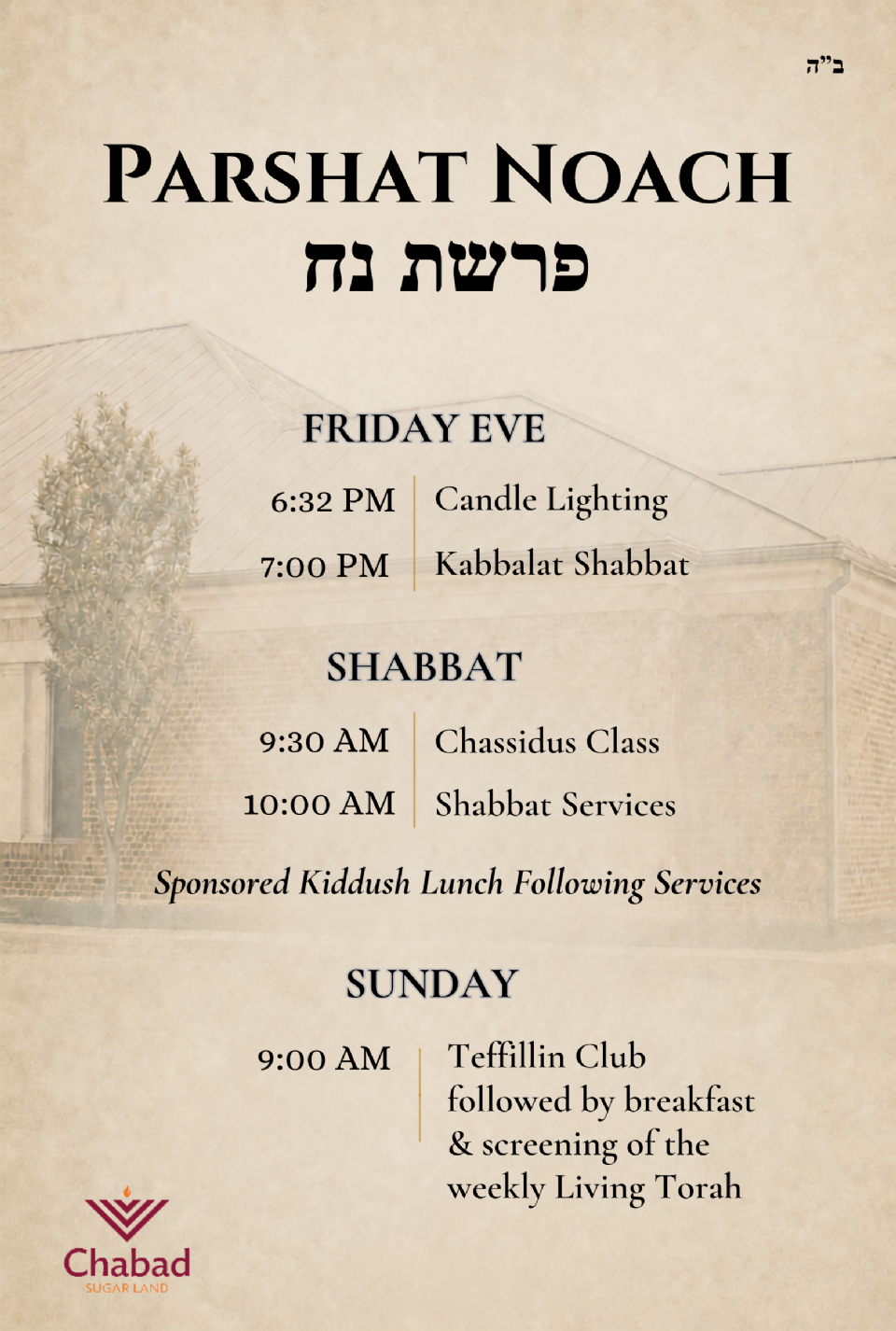
Candle Lighting Times for
Sugar Land, Texas:
Friday, Oct. 16
6:32 pm

Message from the Rabbi

Dear Friends,

When you’re waiting for something important to happen, it’s tempting to sit back and wait for the right moment. But often, the best thing you can do is take a small step to help make that moment arrive sooner.

That’s one of the lessons we learn from this week’s Torah portion, Noach.

After the Great Flood, Noah and his family remained inside the ark until the world was ready for them to leave. But Noah didn’t simply wait. He sent out birds to see whether the waters had receded and the earth was ready for life again. He did what he could to move things forward.

We, too, are waiting for a better world. We pray for an end to the suffering and hatred, for the safety of our fellow Jews, and for a time when all people can live in peace. We may not control when that day arrives, but we can do something to help bring it closer.

Every mitzvah, every act of kindness, and every moment spent helping another person adds light to the world. We can check on a neighbor, give charity, put on tefillin, light Shabbat candles, or offer encouragement to someone who needs it. These actions may seem small, but they make a real difference.

Noah teaches us that we don’t have to wait for the world to change before we start making it better. We can begin right now, with what is within our reach.

May our efforts help bring the day when darkness gives way to lasting light, Moshiach comes, all Jews return to our Promised Land, and the Temple is rebuilt in Jerusalem. Each of us can help bring that day closer, one good deed at a time.

Shabbat shalom,


Service Times:


Click here for the Weekly Encounter with the Rebbe story!

Weekly Parsha Video

Parshat Noach: 

Can regular people do extraordinary things?

Click here to watch!


The Only Person Who Responded to the Ad

By Leibel Gniwisch

The Sixth Lubavitcher Rebbe, Rabbi Yosef Yitzchak Schneersohn


Brownsville buzzed with Jewish life in mid-20th century. A modest neighborhood deep in Brooklyn, its denizens were Jewish immigrants who had lifted themselves up from the poverty-stricken tenements of Manhattan’s Lower East Side.


Of course, there were synagogues. Homey Chassidic shtiebels, larger “Jewish center” types for “alrightniks,” and even Sephardic congregations for the Jews from exotic places like Turkey and Syria.


One particular synagogue was led by a rabbi whose name we no longer know. What we do know is that he didn’t like the chassidim. We aren’t sure why. It may have been a remnant of the age-old feud between chassidim and mitnagdim or personal animus.

Whatever it was, the rabbi often mocked his Chassidic coreligionists. Most notably, the rabbi derided the Lubavitcher Rebbe, Rabbi Yosef Yitzchak Schneersohn.


But one day, the rabbi stood up to address his congregants, declaring a complete change of heart.


“I have something to say,” he announced from the pulpit. “I was wrong about the Lubavitcher Rebbe and I want to apologize publicly for the way I’ve portrayed him in the past.”


“Why? What happened?” asked the shul members in surprise.


The rabbi answered with a personal story. “As you know, I have a brother. Recently, he’s been diagnosed with a serious illness. He needed money, a lot of it, and he reached out to me for help.” The rabbi mopped the sweat that began to bead on his forehead.


“I thought about asking you, my congregants, but the sum was too large and I knew you needed the money for your families.


So I did what seemed to be the only viable option: I placed a classified ad in the Morgen Journal* with four words and my phone number. ‘Ah Yid darf hilf (a Jew needs help),’ I wrote, hoping for the best. I was desperate.


“Do you know who was the only one to answer my classified? The Lubavitcher Rebbe. He called me and offered to donate the full amount.


“This is why I am apologizing. Rabbi Yosef Yitzchak is a true leader of the Jewish people. He didn’t know who I was or whether I belonged to his movement, he simply saw that a Jew needed help and that was enough for him.”


Heard from Brownsville native Rabbi Mendel Baumgarten(1917-2019)


*A Yiddish New York newspaper with a wide readership, founded in 1901.


Question:

I try to make Friday night dinner a special family occasion, but frankly, it's a lot of work. Getting everyone together, preparing the food, setting the table, making Kiddush. And half the time the kids are fighting or complaining. Sometimes I wonder if I’m really achieving anything by making Shabbos dinner. Help?


Answer:

You have no idea how huge an impact your Shabbos dinners are having. You are making history and fixing the world. And feeding your family too. 


Shabbos dinner is a cosmic event, a journey from Creation to the coming of Moshiach. Each element adds another dimension and conveys a deep message.

We start with Kiddush , recalling how G-d created the world in six days and rested on the seventh. The universe has a Creator, and He made it for a purpose.


Then we drink the wine, correcting the very first human mistake. Adam and Eve ate the forbidden fruit, which according to one opinion in the Talmud was a grape. They used the fruit for something forbidden. We use it for a mitzvah. 


Next we wash our hands , taking us to Noah's Flood. The world had become so corrupt that it needed to be washed clean.

But instead of waiting for a flood to purify us, we wash our own hands. We can clean up our own mess. 


Then comes the challah dipped in salt . This reminds us of Sodom, a society so selfish that people wouldn't even share salt with a neighbour.

We do the opposite. We put salt on our bread and share it generously with family, friends and guests. Where Sodom shut people out, our Shabbos table welcomes them in.


Not bad. We fixed the sin of Adam and Eve, the generation of the Flood and Sodom, and we haven't even reached the first course.


So then comes the meal itself . We enter the world of food, appetite and pleasure, just as our ancestors descended into Egypt, where they became slaves. And we too can become slaves to our physical desires.


But when we enjoy our food with gratitude and holiness, rather than being controlled by the material world, we elevate it.

That's our own little Exodus.


During the meal we share words of Torah , bringing us to Mount Sinai. A thought on the parsha, a question, a story or a lively debate. The same Torah given thousands of years ago comes alive again at our table.


Finally, Birkat Hamazon , Grace After Meals, takes us into the future. We pray for Jerusalem to be rebuilt, for the return of the Temple and for the coming of Moshiach, when the world will finally fulfil its purpose.


And so, in the space of one meal, we have travelled from Creation to Redemption. From Noach to Sodom, from Egypt to Sinai, from the beginning of history to its climax.


But how do we get there? What moves the world from its messy beginnings to its ultimate glorious destination?


It's what happens around your table. 

The conversations with your kids. The guests you welcome. The Torah you share. The Jewish memories you create. The stories you tell. The values you pass on.


We think of history as something that happens on a grand stage. But the real stage is our dining room. Even if the kids are fighting and the soup is spilling, you're still creating a Jewish home, passing on a tradition and building the future. 


Don’t give up your Shabbos dinners. The work is worth it. You are making history over a bowl of chicken soup.


Good Shabbos,
Rabbi Moss


Sources:

Kiddush and Creation:
Sefer Hakanah asks why don’t we have a Haggadah to commemorate creation like we have for the Exodus? And answers: We do. Don’t you say Kiddush Friday night? That is the Haggadah of creation.

The Flood as purification:
Torah Ohr Parshas Noach  "The purification of the world was accomplished through the Flood. The forty days of rain were like the forty se'ah (liquid measures) of a mikveh."

Salt, Sodom and hospitality:
Bereishis Rabbah 50:4, quoted by Rashi on Bereishis 19:26. Lot asked his wife to bring salt for their guests, and she objected to introducing the custom of hospitality into Sodom. 

Exodus and materialism:
Sichas Acharon Shel Pesach 5721 (1961), sections 42–44 . "The descent into Egypt was to refine and elevate the sparks of holiness found there. Sparks of holiness are concealed within physical objects and must be elevated through our Divine service.”


Parshah Riddle:

How long did the Mabul (Flood) last?

A) 40 days

B) 150 days

C) One full year

D) 40 days and 40 nights

Latest from www.ChabadSugarland.com

  
By the Numbers
Use These 12 Yiddish Phrases to Impress Your Chabad Rabbi
Some phrases in particular practically shout “Chabad!” These phrases capture key ideas of Chabad philosophy and lifestyle.
  
Your Questions
What Happened to Noah’s Ark?
Throughout the ages, the location of Noah’s Ark has been a subject of fascination, with some even claiming to have found it.
  
Quiz
Take the Tower of Babel Quiz
What was the stated motivation of the builders?
  
Freeman Files
Hashem Is So Proud of You
The Master Gardener of the universe takes pride in everything about you.

Parshah in a Nutshell


Parshat Noach

The Parshah is named "Noach" (Noah) after the protagonist of its major event: The Great Flood. It is found in Genesis 6:9.

G‑d instructs Noah— the only righteous man in a world consumed by violence and corruption—to build a large wooden teivah (“ark”), coated within and without with pitch. A great deluge, says G‑d, will wipe out all life from the face of the earth; but the ark will float upon the water, sheltering Noah and his family, and two members (male and female) of each animal species (and 7 of the " pure" species).

Rain falls for 40 days and nights, and the waters churn for 150 days more before calming and beginning to recede. The ark settles on Mount Ararat, and Noah dispatches a raven, and then a series of doves, “to see if the waters were abated from the face of the earth.” When the ground dries completely—exactly one solar year (365 days) after the onset of the Flood—G‑d commands Noah to exit the teivah and repopulate the earth.

Noah builds an altar and offers sacrifices to G‑d. G‑d swears never again to destroy all of mankind because of their deeds, and sets the rainbow as a testimony of His new covenant with man. G‑d also commands Noah regarding the sacredness of life: murder is deemed a capital offense, and while man is permitted to eat the meat of animals, he is forbidden to eat flesh or blood taken from a living animal.

Noah plants a vineyard and becomes drunk on its produce. Two of Noah’s sons, Shem and Japheth, are blessed for covering up their father’s nakedness, while his third son, Ham, is punished for taking advantage of his debasement.

The descendants of Noah remain a single people, with a single language and culture, for ten generations. Then they defy their Creator by building a great tower to symbolize their own invincibility; G‑d confuses their language so that “one does not comprehend the tongue of the other,” causing them to abandon their project and disperse across the face of the earth, splitting into seventy nations.

The Parshah of Noach concludes with a chronology of the ten generations from Noah to Abram (later Abraham), and the latter’s journey from his birthplace of Ur Casdim to Charan, on the way to the land of Canaan.

Learn: Noach in Depth
Browse: Noach Parshah Columnists
Prep: Devar Torah Q&A for Noach
Read: Haftarah in a Nutshell
Play: Noach Parshah Quiz


Today's Quote

Your fellow is your mirror. If your own face is clean, the image you perceive will also be flawless. But should you look upon your fellow man and see a blemish, it is your own imperfection that you are encountering -- you are being shown what it is that you must correct within yourself.
— Rabbi Israel Baal Shem Tov

Chabad World News