A Time to Dance! This Saturday
ב"ה

The Chabad of Sugar Land Weekly Newsletter

Icon
Candle Lighting Times for
Sugar Land, Texas:
Friday, Oct. 2
6:48 pm

Message from the Rabbi

Dear Friends,

Remarkable. Lucky. Heroic. These words have been used to describe the rescue of the Flydubai flight bound for Israel. But to me, and to so many others, another word comes to mind: miraculous.

An injured captain opened the cockpit door. Passengers and crew rushed to intervene. Together, they pulled a flight on the brink of disaster back toward safety. Behind every headline are people who can now return to their families—and families who have every reason to give thanks.

During Sukkot, we remember the clouds of glory that sheltered our ancestors in the desert. Sitting beneath the sukkah’s simple roof, we are reminded that our deepest security comes from G-d.

That protection can come through extraordinary human courage: a wounded pilot, determined passengers, or police officers who stand between a gunman and Jews gathered for Yom Kippur prayers, as happened in Belleville, Ontario.

We thank these heroes. We pray for the injured. And we thank G-d for the lives spared.

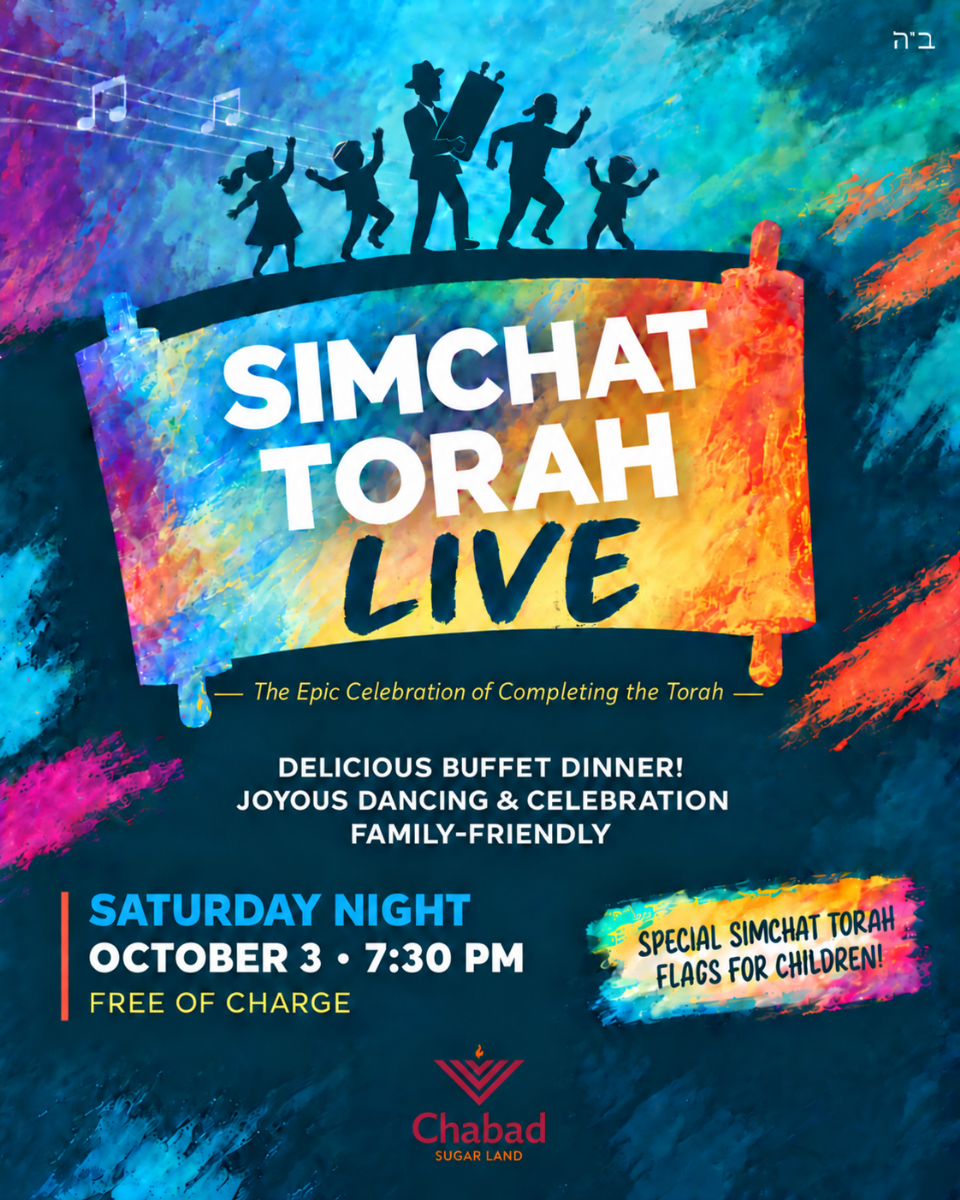
This coming Saturday night, we will celebrate Simchat Torah. We will dance with gratitude for these miracles and pray for a year of safety, healing, and peace.

We will also remember those murdered on Simchat Torah three years ago. Their absence remains painful. Our dancing carries their memory, too—a declaration that Jewish life, faith, and joy continue.

You don’t need to know the steps or be a Torah scholar to join. Simchat Torah belongs to every Jew, and there is room in the circle for you.

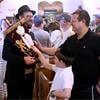
Join us at Chabad on Saturday night, October 3, at 7:30 PM, for a full buffet dinner, joyous dancing, and special flags for children. Bring the family—and a friend!

Let’s turn our gratitude into joy, together.

Chag same’ach!

Rabbi Feigenson


Service Times:


Click here for the Weekly Encounter with the Rebbe story!

Weekly Parsha Video

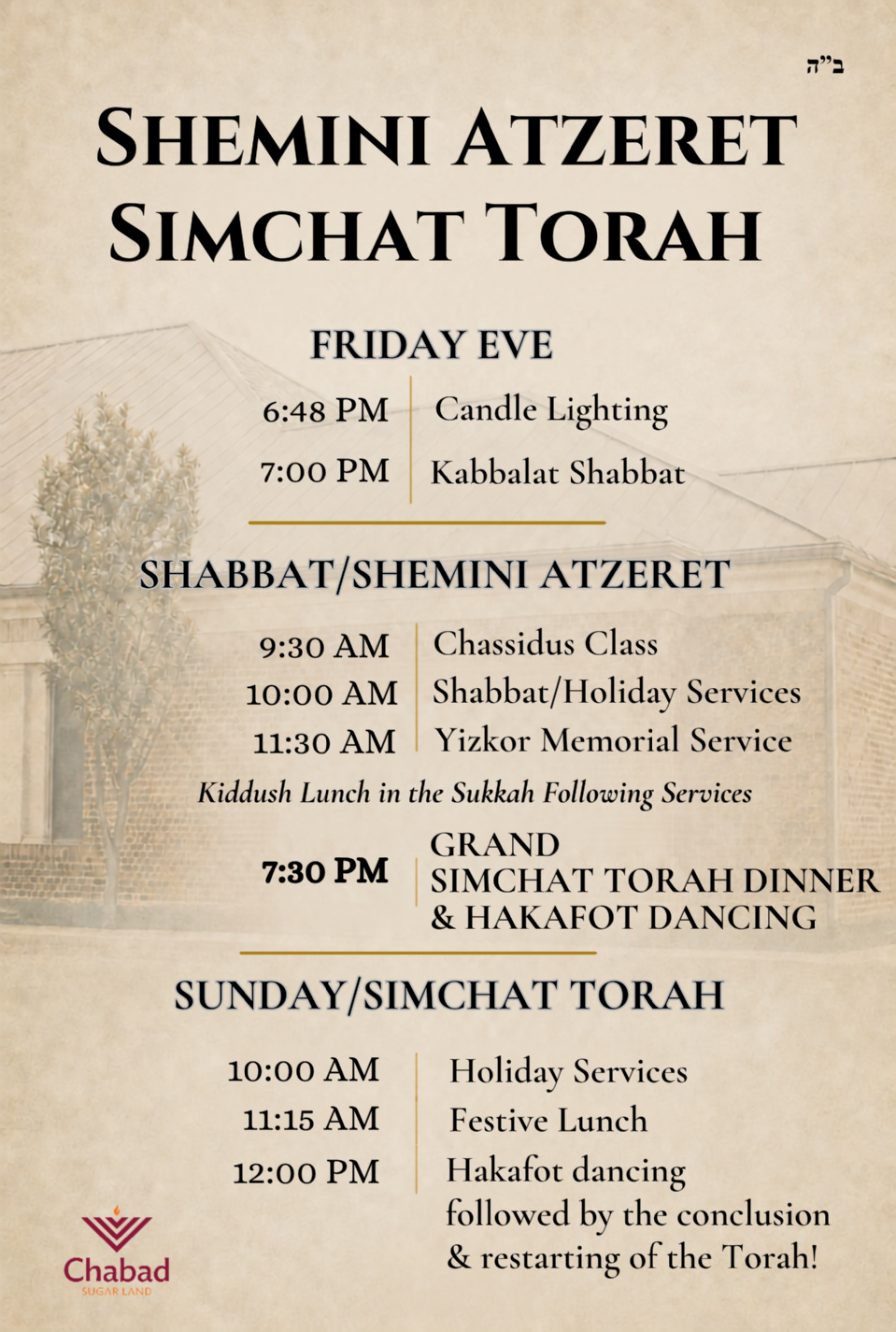
Shmini Atzeret/Simchat Torah:

Understanding the Unlimited Joy of Simchat Torah.


"This Is My Torah Scroll"

By Ruth Benjamin


Avraham was very young in 1945, when the War ended and solitary survivors tried frantically to trace their relatives.


He had spent what seemed to be most of his life with his nanny, who had hidden him away from the Nazis at his father's request. There was great personal risk involved, but the woman had readily taken it, as she loved the boy.


All the Jews were being killed, and Avraham's nanny did not think for a moment that the father, Joseph Foxman, would survive the infamous destruction of the Vilna Ghetto.

He would surely have been transferred to Auschwitz -— and everyone knew that nobody ever came back from Auschwitz.


She therefore had no scruples about adopting the boy, having him baptized into the Catholic Church and taught catechism by the local priest.


It was Simchat Torah when his father came to take him.

The heartbroken nanny had packed all his clothing and his small catechism book, stressing to the father that the boy had become a good Catholic.

Joseph Foxman took his son by the hand and led him directly to the Great Synagogue of Vilna. On the way, he told his son that he was a Jew and that his name was Avraham.


Not far from the house, they passed the church and the boy reverently crossed himself, causing his father great anguish. Just then, a priest emerged who knew the boy, and when Henryk rushed over to kiss his hand, the priest spoke to him, reminding him of his Catholic faith.


Everything inside of Joseph wanted to drag his son away from the priest and from the church. But he knew that this was not the way to do things. He nodded to the priest, holding his son more closely. After all, these people had harbored his child and saved the child's life.

He had to show his son Judaism, living Judaism, and in this way all these foreign beliefs would be naturally abandoned and forgotten.


They entered the Great Synagogue of Vilna, now a remnant of a past, vibrant Jewish era. There they found some Jewish survivors from Auschwitz who had made their way back to Vilna and were now rebuilding their lives and their Jewish spirits.

Amid the stark reality of their suffering and terrible loss, in much diminished numbers, they were singing and dancing with real joy while celebrating Simchat Torah.


Little Avraham stared wide-eyed around him and picked up a tattered prayer book with a touch of affection.

Something deep inside of him responded to the atmosphere, and he was happy to be there with the father he barely knew. He held back, though, from joining the dancing.


A Jewish man wearing a Soviet Army uniform could not take his eyes off the boy, and he came over to Joseph. "Is this child... Jewish?" he asked, a touch of awe in his voice.


The father answered that the boy was Jewish and introduced his son.


As the soldier stared at young Avraham, he fought to hold back tears. "Over these four terrible years, I have traveled thousands of miles, and this is the first live Jewish child I have come across in all this time."


"Would you like to dance with me on my shoulders?" he asked the boy, who was staring back at him, fascinated.


The father nodded permission, and the soldier hoisted the boy high onto his shoulders. With tears now coursing down his cheeks and a heart full of real joy, the soldier joined in the dancing.

"This is my Torah scroll," he cried.


Abe Foxman, the national director of the Anti-Defamation League — the Avraham in our story — remembers this as his first conscious feeling of a connection with Judaism and of being a Jew.


Question: 

Why Are the Jews Called “People of the Book”?


Answer:

Throughout history, Jews have been called the “People of the Book” (or “Am HaSefer”) by both Jews and non-Jews.

The simple and most obvious reason for this is the strong and eternal bond between the Jews (the people) and the Torah (the book), which includes both the written and oral traditions, and all of the works that expound upon them.


Indeed, Jews are constantly studying or lecturing on various Torah texts.

It is the Torah that has kept our people alive, sustaining us throughout our long and turbulent history.

Source of the Term

Many point to Islam as the origin of this title. Indeed, although Islamic tradition sometimes considers Jews to be infidels, they are also referred to as “People of the Book.” Islam recognized that the Jewish people were in possession of a revelation from G‑d—namely the Torah—that was recorded before the advent of Islam.

Thus, they were tolerated to the extent that they were permitted to live among Muslims, as long as they followed certain restrictions and paid a special tax.


However, this is not the source of the title, but instead a reflection of the deep and intrinsic bond between the Jewish people and “the book,” a.k.a. “the Torah.”

The Book Is a Person

To the Jewish people, the Torah is more than a source of wisdom or a guide to life. Rather, it is a living, breathing partner, with whom we enter into a lifelong relationship. The Talmud refers to the bond between the Jewish people and the Torah as one between a betrothed couple. Furthermore, the Midrash states that the very purpose of the Torah was for the Jewish people.


Torah is considered the life-force of the Jew, as seen in the following incident with Rabbi Akiva:


Once, the wicked government [of Rome] decreed that the Jewish people were forbidden to study Torah. Pappus ben Judah saw Rabbi Akiva convening gatherings in public and studying Torah [with them]. Said he to him: “Akiva, are you not afraid of the government?”

Said [Rabbi Akiva] to him: “I’ll give you a parable.

“A fox was walking along a river and saw fish rushing to and fro. Said he to them: ‘What are you fleeing?’

“Said they to him: ‘The nets that the humans spread for us.’

“Said he to them: ‘Why don’t you come out onto the dry land? We’ll live together, as my ancestors lived with your ancestors.’

“Said they to him: ‘Are you the one of whom it is said that you are the wisest of animals? You’re not wise, but foolish! If, in our environment of life we have cause for fear, how much more so in the environment of our death!’

“The same applies to us. If now, when we sit and study the Torah, of which it is said, ‘For it is your life and the lengthening of your days,’ such is our situation, how much more so if we neglect it . . .”


As the classic phrase based on the Zohar succinctly put it, “The Jews and the Torah are one.”


Thus, it is no wonder that we Jews have a holiday called Simchat Torah, in which we literally dance with a Torah scroll.


(for more on this, see Is It True That Jews Dance With Books? and On Simchat Torah, a Jew Never Dances Alone).


As the recently departed Rabbi Adin Even-Israel (Steinsaltz) succinctly put it, “This is a Jew! One who kisses a book when he puts it down after reading from it.”


For more on this, see Bibliaphilia - A reflection on why Jews kiss Torah books.


Parshah Riddle:

What is the name of the very last Torah portion - which we are concluding this Simchat Torah?


Answer to last week's riddle:

Passages that discuss the festivals and passages that discuss the special festive sacrifices brought in the Holy Temple.

Latest from www.ChabadSugarland.com

  
By the Numbers
14 Wacky and Wonderful Things Jews Do with Water
Water shows up in all sorts of places in Jewish life, from holiday traditions to everyday practices.
  
Freeman Files
Yizkor of the Child Who Would Rather Not Remember
In the same way others live in space, Jews live in time. It’s all here, all at once.
  
Quiz
Take the Shemini Atzeret / Simchat Torah True or False Quiz
What does this day even commemorate, and how do we celebrate?
  
Video
Simchat Torah and Inheriting the Torah
Learn how the verse Torah Tzivah in the last Torah portion, which describes Torah as an unforsaken inheritance, conveys the theme of Simchat Torah. Understanding the level of joy on Pesach, Shavuot and Sukkot, together with the advantage of Teshuvah, sheds light on the joy of Simchat Torah.

Parshah in a Nutshell

The name of the Parshah, "V'Zot HaBerachah," means "And this is the blessing," and it is found in Deuteronomy 33:1.

The Sukkot and Shemini Atzeret Torah readings are from Leviticus 22-23, Numbers 29, and Deuteronomy 14-16. These readings detail the laws of the moadim or " appointed times" on the Jewish calendar for festive celebration of our bond with G‑d; including the mitzvot of dwelling in the sukkah (branch-covered hut) and taking the " Four Kinds" on the festival of Sukkot; the offerings brought in the Holy Temple in Jerusalem on Sukkot, and the obligation to journey to the Holy Temple to "to see and be seen before the face of G‑d" on the three annual pilgrimage festivals — Passover, Shavuot and Sukkot.

On Simchat Torah ("Rejoicing of the Torah") we conclude, and begin anew, the annual Torah-reading cycle. First we read the Torah section of V'zot HaBerachah, which recounts the blessings that Moses gave to each of the twelve tribes of Israel before his death. Echoing Jacob's blessings to his twelve sons five generations earlier, Moses assigns and empowers each tribe with its individual role within the community of Israel.

V'zot HaBerachah then relates how Moses ascended Mount Nebo from whose summit he saw the Promised Land. "And Moses the servant of G‑d died there in the Land of Moab by the mouth of G‑d... and no man knows his burial place to this day." The Torah concludes by attesting that " There arose not a prophet since in Israel like Moses, whom G‑d knew face to face... and in all the mighty hand and the great awesome things which Moses did before the eyes of all Israel."

Immediately after concluding the Torah, we begin it anew by reading the first chapter of Genesis (the beginning of next Shabbat's Torah reading) describing G‑d's creation of the world in six days and His ceasing work on the seventh—which He sanctified and blessed as a day of rest.

Learn: From the Rebbe's Talks
Browse: V'Zot HaBerachah Parshah Columnists
Prep: Devar Torah Q&A for V'Zot HaBerachah
Read: Haftarah in a Nutshell
Play: V'Zot HaBerachah Parshah Quiz


Today's Quote

A voice is heard on high, lamentation, bitter weeping; Rachel weeping for her children, she refuses to be comforted for her children, for they are not. So says the L-rd: Refrain your voice from weeping and your eyes from tears, for there is reward for your work, says the L-rd, and they shall come back from the land of the enemy...
— Jeremiah 31:14-15

Chabad World News