Why the Adidas on Yom Kippur?
ב"ה

The Chabad of Sugar Land Weekly Newsletter

Icon
Candle Lighting Times for
Sugar Land, Texas:
Friday, Sep. 18
7:05 pm
Sunday, Sep. 20
7:03 pm

Message from the Rabbi

Dear Friends,

When a parent reprimands a child, the child doesn’t always respond by calmly changing their behavior. Often, they get defensive and frustrated, or even double down. The parent may be right, but the child is focused on what they were doing and doesn’t yet see the bigger picture.

There’s an interesting lesson about this in this week’s Torah portion, Haazinu. Moses’s final words to the Jewish people are written as a song. And it’s a song that includes both praise and criticism, the good moments and the difficult ones, the mistakes and the hope for what comes next.

G-d’s message to His people is not simply a list of everything we’ve done wrong. It’s a reminder that our entire relationship with Him, including our failures, is part of a much larger story. Even when we make mistakes, the connection remains. There’s always a way forward.

That message is especially meaningful as we approach Yom Kippur. It’s easy to think of the day as a long list of things we need to fix. But Judaism asks us to look deeper. Yom Kippur reminds us who we are at our core and that our relationship with G-d can never be erased by our mistakes.

There’s a lesson here for all of us, especially as parents. When someone we love needs correction, we can focus entirely on what they did wrong, or we can remind them of the bigger relationship. We can correct without making them feel rejected.

Sometimes, instead of another scolding, what people need is a song that reminds them they are still part of the story.

Shabbat shalom,


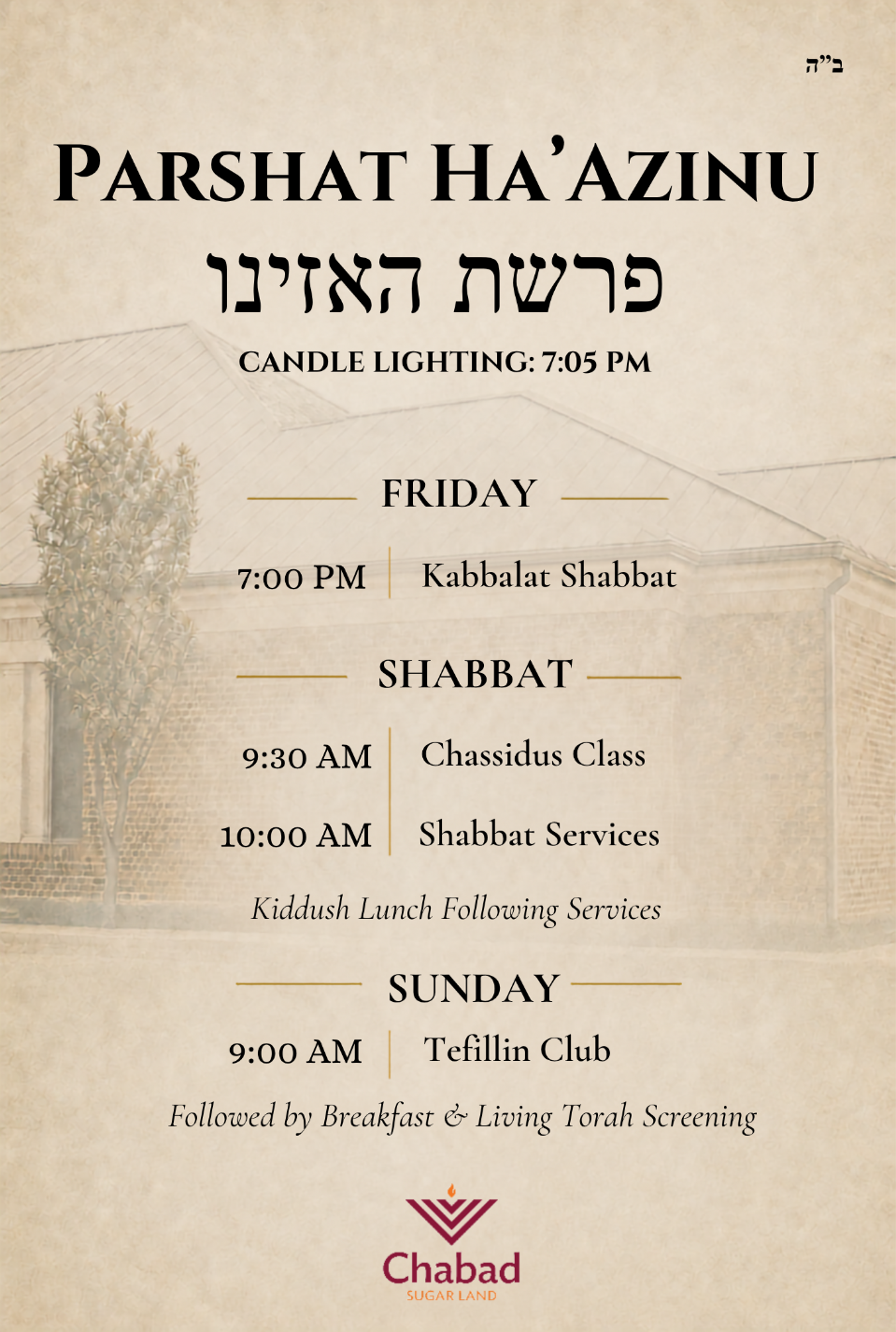
Service Times:


Click here for the Weekly Encounter with the Rebbe story!

Weekly Parsha Video

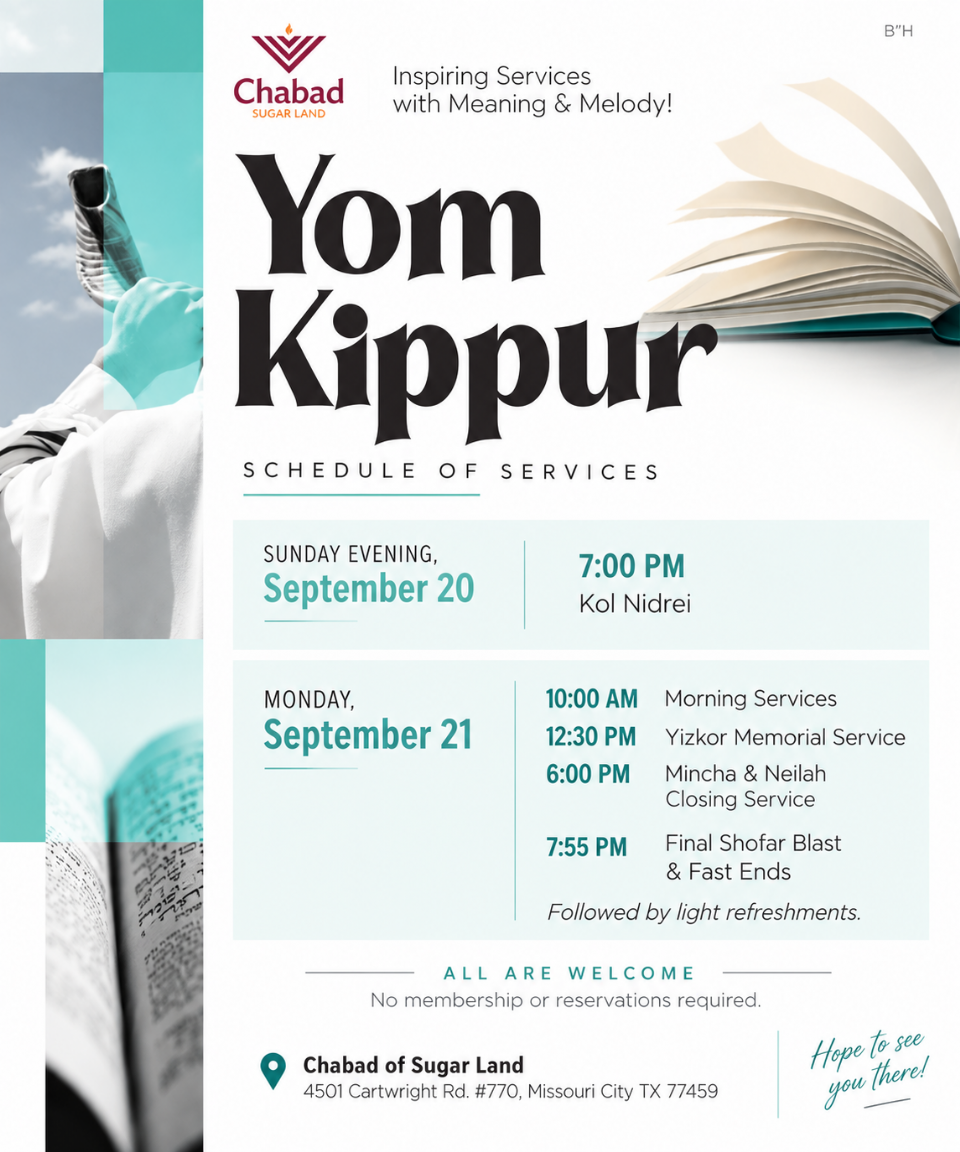
Discover your divine bliss on Yom Kippur.

Click here to watch!


Higher Than Heaven

By Shula Bryski


It was the night of Yom Kippur, the holiest time of the year.


As all the Jews were gathering in shul anxiously awaiting their rebbe’s arrival to begin the prayer services, Rabbi Shneur Zalman, also known as the Alter Rebbe, mysteriously left the small European village.


Some of his devoted and admiring chassidim speculated that their beloved leader went to heaven, connecting to G‑d and His angels in the heavenly spheres in preparation for this holy time.


Where was their beloved leader?


As the Rebbe’s chassidim waited worriedly for him to arrive, he was climbing deep into the woods, with a sack on his back, to chop down wood.


They later learned that he then proceeded to bring the firewood and the sack into the lonely little house of an impoverished widow who had just given birth and her five small children.

Saving a life is so important, that chopping wood and creating fire—normally forbidden on the holy day—are permitted.


No task was beneath this great Torah scholar as he created a blazing fire in the fireplace, unpacked the food and clothes from the sack, lovingly fed the children and left the woman with many kind and caring words.


Perhaps we could say that the Alter Rebbe went to a place even higher than heaven.

---

What is true goodness? What is true giving?


True goodness and giving often involves nurturing and caring in little ways that go unseen.


Judaism gently teaches us through the stories of the scroll that true goodness is not carried out in a blaze of glory.

True goodness and giving often involves nurturing and caring in little ways that go unseen.


Often when it’s hard.

Often when it hurts.

Often when it’s not really “my job.”


Impacting this world is not reserved for the knight in shining armor, for the airbrushed faces of Hollywood.


It is the responsibility and right of every one of us—with all of our talents and strengths, and yes, with all of our weaknesses.


We, and our loved ones, are immortalized long after we are gone, through the kind acts on this earth—the comforting whisper to a frightened child, the mending of a broken heart, the giving of charity when we need to dig deep, the patience and forbearance to a cantankerous relative, the nourishing home-cooked meal delivered with love . . .


It is through this goodness and giving that we touch the divine, ascending higher than heaven.


Question:

I always found it funny that on Yom Kippur we don't wear leather shoes. Everyone shows up to shul in suits and sneakers. But leather belts are fine. Why? What do we have against leather shoes? Was Kol Nidrei sponsored by Adidas?


Answer:

Some have suggested that the reason for wearing runners on Yom Kippur is because it's a fast day.

But I think there is something deeper.


Shoes have a unique job. They cover the lowest part of the body, the part that touches the ground, separating us from the earth beneath our feet.

And that gives the shoe a spiritual meaning. It represents where the soul meets the ground.


Inside us is a G-dly soul that reaches upwards, seeking meaning, goodness and holiness. But on the outside, we are just another animal, driven by instinct, appetite and self-interest.


That is the human condition. We are angels in leather shoes. Our deepest self is holy, but our touchpoint with the physical world can be very animalistic.


Our task is to bring those two worlds together, to make even the animal live a G-dly life. Sometimes we succeed, and sometimes we don’t. It’s a lifelong battle between our higher self and our lower urges. 


But Yom Kippur is different.


On that day, we don’t fight the animal. For a few precious hours, we transcend it. We don't eat or drink. We step away from bodily pleasures and comforts. And we remove the leather shoes from our feet.


Beneath all the layers, beneath our appetites and distractions, beneath our mistakes and regrets, there is a soul that was always pure.


For one day a year, we don't need to wrestle with the animal. We step out of its skin, and our true self is free to shine. 


So perhaps Adidas does belong at Kol Nidrei. The shoes may be synthetic, but the soul is the real thing. 


Good Shabbos and Good Yomtov,
Rabbi Moss


Source:
Likkutei Torah, Shir HaShirim 44a


Parshah Riddle:

What two things does Moshe Rabeinu call upon as witnesses as he begins his song?


Latest from www.ChabadSugarland.com

  
By the Numbers
15 Historical Events That Happened on Yom Kippur
Quite a number of things happened on Yom Kippur.
  
Your Questions
Can I Use (or Reuse) a Yahrzeit Candle for Something Else?
Is it considered a candle made specifically for the departed?
  
Freeman Files
Jews Don't Repent
Thirteen essays and stories that explore the what, why and how of of the most powerful force known to man--the power of self-transformation
  
Quiz
Take the Yom Kippur Who Am I Quiz
Test your knowledge of the characters of Yom Kippur.

Parshah in a Nutshell


Parshat Ha'Azinu

The name of the Parshah, "Haazinu," means "Listen" and it is found in Deuteronomy 32:1.

The greater part of the Torah reading of Haazinu (“Listen In”) consists of a 70-line “song” delivered by Moses to the people of Israel on the last day of his earthly life.

Calling heaven and earth as witnesses, Moses exhorts the people, “Remember the days of old / Consider the years of many generations / Ask your father, and he will recount it to you / Your elders, and they will tell you” how G‑d “found them in a desert land,” made them a people, chose them as His own, and bequeathed them a bountiful land. The song also warns against the pitfalls of plenty—“Yeshurun grew fat and kicked / You have grown fat, thick and rotund / He forsook G‑d who made him / And spurned the Rock of his salvation”—and the terrible calamities that would result, which Moses describes as G‑d “hiding His face.” Yet in the end, he promises, G‑d will avenge the blood of His servants, and be reconciled with His people and land.

The Parshah concludes with G‑d’s instruction to Moses to ascend the summit of Mount Nebo, from which he will behold the Promised Land before dying on the mountain. “For you shall see the land opposite you; but you shall not go there, into the land which I give to the children of Israel.”

Learn: Haazinu Rashi Studies
Browse: Haazinu Parshah Columnists
Prep: Devar Torah Q&A for Haazinu 
Read: Haftarah in a Nutshell
Play: Haazinu Parshah Quiz


Chabad World News

  
North America
At Wilfred Laurier University, Mezuzah Vandalism Meets Its Waterloo
  
Europe
Denmark’s Mainland Gets High Holiday Services—and First Jewish Center in Decades
  
Holiday Watch
My Father’s Machzor
In 1951 my father, Rabbi Moshe Greenberg, was twenty years old and a prisoner in a Soviet labor camp in Siberia. That Yom Kippur, he faithfully prayed all the day’s prayers. All, that is, except for Kol Nidrei.
  
Ukraine War
Ukrainian Jews Mark Fifth Year of Wartime High Holidays