Is Jewish Prayer Too Patriarchal?
ב"ה

The Chabad of Sugar Land Weekly Newsletter

Icon
Candle Lighting Times for
Sugar Land, Texas:
Friday, Sep. 4
7:22 pm

Message from the Rabbi

Dear Friends,

There’s something powerful about everyone showing up. At a wedding, graduation, or championship game, the experience feels different when everyone is there. We’re reminded that we’re part of something larger than ourselves.

This week’s Torah portion gives us a similar image as we approach Rosh Hashanah. The Torah says, “You are all standing here today.” The Baal Shem Tov taught that “today” refers to Rosh Hashanah. Before the new year begins, every Jew stands together before G-d.

The Torah then goes out of its way to list all kinds of people: leaders and followers, scholars and workers, woodchoppers and water-carriers.

Jewish unity doesn’t mean we’re all the same. Each of us has a different background and role. Yet on Rosh Hashanah, we’re reminded that beneath all those differences, we share the same essential connection.

This Saturday night, we begin saying Selichot, the special prayers traditionally recited in the days leading up to Rosh Hashanah. Selichot give us an opportunity to reflect on the year that’s ending and to think about the kind of year we want to build.

But preparation for Rosh Hashanah isn’t only about prayer. It’s also about how we show up for other people. An act of kindness or simply being there for someone who needs us can turn the ideals of the High Holidays into something real.

As we prepare for the new year, may we all stand together, each in our own way, and enter the year ahead with greater purpose and joy.

Shabbat shalom,


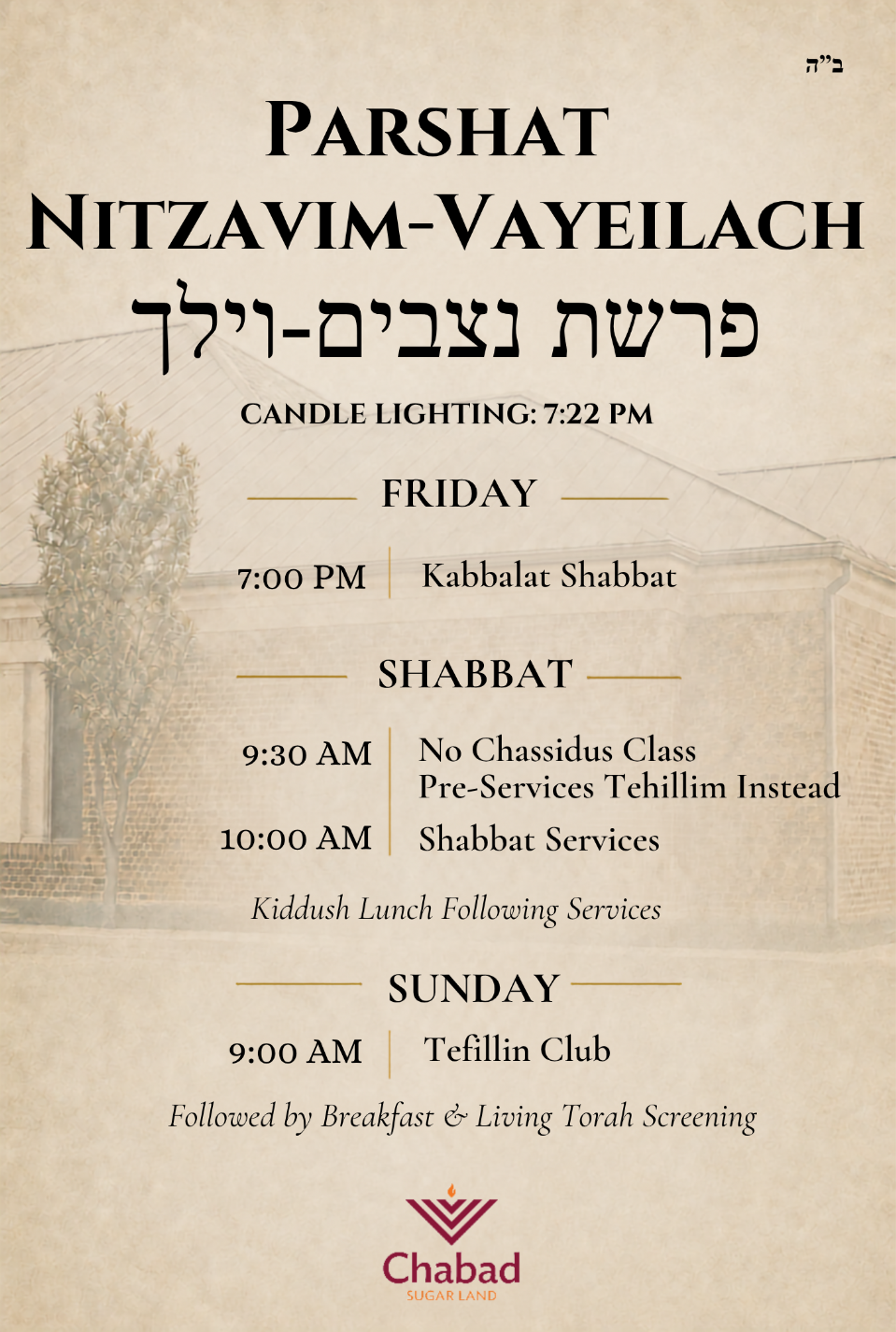
Service Times:


Click here for the Weekly Encounter with the Rebbe story!

Weekly Parsha Video

Parshat Nitzavim-Vayelich: 

How to Create True Joy, Even in Your Lowest Moments.


The Rabbi, the Bandit, and the Shabbat Miracle

Chabad.org Staff

Rabbi Yosef Chaim, the Ben Ish Chai.


The loud argument between the two men shattered the morning's calm. The attendant of the rabbinical court opened the door and was surprised by the sight before him.


This was the court of Rabbi Yosef Chaim of Baghdad (1835-1909), renowned as the Ben Ish Chai, after the title of his famous book. Although he had declined to serve as Baghdad’s official rabbi, he was revered by everyone. Thousands flocked to hear his sermons, and people from every level of society listened attentively to his words. His home, too, was always open to anyone seeking guidance.


The litigants standing at the entrance made an unusual pair: one was a poor Jew, and the other an Arab. The Arab was the plaintiff, the Jew was the defendant.


The Arab began to speak. He claimed that the Jew had stolen his money and refused to return it. “We already went to the Muslim court,” the Arab explained. “The Jew denied stealing the money, and the judge ruled in his favor. So I asked him to come with me to the rabbi’s court. Perhaps here he will admit the truth.”


Rabbi Yosef Chaim asked to speak privately with the Jew.


“Is his money really in your possession?” he asked directly.

The Jew could not bring himself to lie while looking into the eyes of the great sage. He lowered his gaze.

“Yes,” he admitted. “I wanted to return the money, but I am desperately poor and have no way to obtain it. That is why I denied the debt in court. I knew that if I could not repay it immediately, I would be thrown into prison.”


The rabbi called the plaintiff back into the room. Opening a drawer, the rabbi removed a bundle of banknotes and handed it to the Arab.

“You did well by coming here,” he said. “All Jews are one extended family. I will pay the debt on this man’s behalf. When his situation improves, he will repay me.”


Rabbi Yosef Chaim’s noble act deeply impressed the plaintiff. Judging by the Jewish man’s poverty, it was clear that the rabbi was unlikely to see his money again anytime soon.


Years passed.


On the twenty-second day of Nissan in the year 5629 (1869), Rabbi Yosef Chaim finally decided to fulfill his dream. Accompanied by his brother and several wealthy Jews from Baghdad, he set out for the Holy Land.


The journey took them across deserts filled with danger. The greatest threat came from bands of robbers who lay in wait for travelers. No one dared cross the desert alone. Travelers would wait until a large group had assembled and then set out together in a caravan of camels accompanied by armed guards.


When Rabbi Yosef Chaim and his companions arrived at the caravan gathering point, they discovered that the caravans continued traveling on Shabbat. Rabbi Yosef Chaim refused to join them.


Instead, he searched for a guide who would agree, in exchange for a generous payment, to stop traveling before Shabbat began on Friday afternoon and remain in place until Saturday night.


At last, he found a Bedouin guide willing to accept his conditions, and the small caravan set out across the desert.


On Friday afternoon, while they were deep in the wilderness, Rabbi Yosef Chaim informed the Bedouin that they would camp there for Shabbat. He asked the guide to stop, but the man refused as the area was extremely dangerous and rife with bandits. Under no circumstances, he insisted, would he remain there for an entire day.


Without arguing, Rabbi Yosef Chaim and his companions climbed down from their camels. They arranged their belongings in preparation for Shabbat and lit candles shortly before sunset.

Night fell in the vast blackness of the desert. The lights twinkled and could be seen for miles around.


Terrified that robbers might attack, the Bedouin guide slunk away from the group and hid among the rocks. From there, he watched Rabbi Yosef Chaim and his companions.


Rabbi Yosef Chaim recited the Friday-night prayers with deep devotion. He then stood and chanted Kiddush in a pleasant melody. During the meal, he sang the traditional Shabbat songs aloud.


Suddenly, the guide heard a rustling sound.


Turning his head, he saw a band of robbers quietly approaching the camp.

He watched as the leader of the bandits left his men behind and crept closer to the group of Jewish travelers.


A few moments passed. Then, to the Bedouin’s astonishment, the leader turned around and signaled to his men to retreat.


The robbers protested. Why should they give up such easy prey?


The Bedouin heard their leader explain:

“That is a great and holy rabbi. Years ago, when I was in trouble, he came to my aid. A Jewish man owed me money, and the rabbi paid the debt himself. I will not allow anyone to harm him.”


After the robbers disappeared into the darkness, the Bedouin emerged from his hiding place and rushed toward Rabbi Yosef Chaim. He fell to his knees and begged the rabbi’s forgiveness, now realizing that he was in the presence of a holy man.


After Shabbat, the group continued on its way and soon arrived safely in the Land of Israel. Rabbi Yosef Chaim visited the graves of the Patriarchs and other holy sites. Toward the end of Elul that year, he returned safely to his home in Baghdad.


Translated from Tzadikim Lamofet, with thanks to Rabbi Hillel Baron


Question:

I'm uncomfortable with the patriarchal nature of prayer. We refer to G-d as our Father, our King, always in the masculine. As a woman, I feel sidelined, as if G-d is a man. Don’t you think the prayers need fixing to make them more suitable to modern sensibilities?


Answer:


If male references to G-d turn you off, then you'll love the services this Rosh Hashanah. 


This year, the first day of Rosh Hashanah falls on Shabbat. As a result, we experience one of the most pleasurable parts of the service: skipping pages in the Prayer Book. 


The prayer "Avinu Malkenu" (Our Father, Our King) is a highlight of the High Holidays. But we don’t read it on Shabbat. The technical reason is that Avinu Malkenu is a series of requests, and on Shabbat we refrain from petitioning G-d for our needs. But there’s something deeper going on here.


On Shabbat, the masculine divine energy steps aside to allow the feminine divine energy to take centre stage. Our Father, Our King moves aside for Our Bride and Our Queen. 


G-d is neither male nor female, but the source of both. In order for us to relate to the Divine, G-d interacts with the world in both masculine and feminine ways.


In a very broad sense, masculine energy seeks to act and change, while feminine energy seeks to nurture and embrace. Masculinity tries to improve reality. Femininity reveals the deeper reality that already exists. Masculine energy fixes its way out of a problem. Feminine energy feels its way beneath it, to discover the deeper meaning within. 


This is the difference between Shabbat and the weekdays.


During the week we try to fix the world. We work at it. We make changes. It's the masculine domain of tinkering with things to make them better.

On Shabbat we enjoy the world for what it is. We bring out the deeper layers, the emotional, the spiritual, the relational connections that lie beneath the surface. That's the feminine domain.

For this reason, Shabbat is called a bride or a queen, the feminine face of the divine that reveals a more profound way of living.


So when Rosh Hashanah falls on Shabbat, we don't say Avinu Malkenu, the prayer that refers to G-d as our Father and King. That prayer asks G-d to heal the sick, vanquish evil and fix the world. That’s the masculine domain. We’ll get back to that on the second day of Rosh Hashanah. But on Shabbat, we don’t appeal to that side. 


Instead, we embrace the Shabbat Bride, the divine feminine, and awaken to a deeper truth: 

The world doesn't always need fixing. Sometimes it just needs to be understood. 

Same with the prayers.


Good Shabbos, 

Rabbi Aron Moss


Parshah Riddle:

What special gathering takes place in the Beit Hamikdash once every seven years?


Answer to last week's riddle:

Levites and Paupers

A Daily Dose of Halachah

The new Daily Halacha Group is where a brief daily voice note - about one minute long - is shared by Rabbi Feigenson, highlighting a practical Jewish law.

The group has now begun learning the laws of Rosh Hashanah, offering a meaningful and accessible way to prepare for the upcoming holiday.

The project was started in memory of his father, Rabbi Peretz Feigenson OBM, who asked in his will that his children study one short section of Jewish law each day.

Join the Daily Halacha group and add one meaningful minute of Torah learning to your day.

Click here to join: https://chat.whatsapp.com/GUi3R2P5cOg1KsNQV4JrPm

Latest from www.ChabadSugarland.com

  
By the Numbers
6 Ways This Year (5787) Is Unique
It's the longest year possible; it begins and ends with Shabbat, and more!
  
Your Questions
Why All the Symbolic Rosh Hashanah Foods?
Why are we rational Jews doing something that seems superstitious?
  
Freeman Files
The Czar in the Field
  
Quiz
Take the Rosh Hashanah Who Am I Quiz
Test your Rosh Hashanah knowledge!

Parshah in a Nutshell


Parshat Nitzavim-Vayelech

The name of the Parshah, "Nitzavim," means "Standing," and it is found in Deuteronomy 29:9. The name of the Parshah, "Vayelech," means "And [Moses] went," and it is found in Deuteronomy 31:1.

The Parshah of Nitzavim includes some of the most fundamental principles of the Jewish faith:

The unity of Israel: “You stand today, all of you, before the L‑rd your G‑d: your heads, your tribes, your elders, your officers, and every Israelite man; your young ones, your wives, the stranger in your gate; from your wood-hewer to your water-drawer.”

The future redemption: Moses warns of the exile and desolation of the Land that will result if Israel abandons G‑d’s laws, but then he prophesies that in the end, “You will return to the L‑rd your G‑d . . . If your outcasts shall be at the ends of the heavens, from there will the L‑rd your G‑d gather you . . . and bring you into the Land which your fathers have possessed.”

The practicality of Torah: “For the mitzvah which I command you this day, it is not beyond you, nor is it remote from you. It is not in heaven . . . It is not across the sea . . . Rather, it is very close to you, in your mouth, in your heart, that you may do it.”

Freedom of choice: “I have set before you life and goodness, and death and evil: in that I command you this day to love G‑d, to walk in His ways and to keep His commandments . . . Life and death I have set before you, blessing and curse. And you shall choose life.”


The Parshah of Vayelech (“ and he went”) recounts the events of Moses’ last day of earthly life. “I am one hundred and twenty years old today,” he says to the people, “and I can no longer go forth and come in.” He transfers the leadership to Joshua, and writes (or concludes writing) the Torah in a scroll which he entrusts to the Levites for safekeeping in the Ark of the Covenant.

The mitzvah of Hakhel (“ gather”) is given: every seven years, during the festival of Sukkot of the first year of the shemittah cycle, the entire people of Israel—men, women and children—should gather at the Holy Temple in Jerusalem, where the king should read to them from the Torah.

Vayelech concludes with the prediction that the people of Israel will turn away from their covenant with G‑d, causing Him to hide His face from them, but also with the promise that the words of the Torah “ shall not be forgotten out of the mouths of their descendants.”

Learn: Nitzavim-Vayelech in Depth
Browse: Nitzavim-Vayelech Parshah Columnists
Prep: Devar Torah Q&A for Nitzavim-Vayelech
Read: Haftarah in a Nutshell
Play: Nitzavim-Vayelech Parshah Quiz


Today's Quote

The work of My hands is drowning in the sea, and you wish to sing before me?
— G-d to the angels, when the Egytians were drowning in the sea (Talmud, Sanhedrin 39b)

Chabad World News