Should Fear Keep You Away?
ב"ה

The Chabad of Sugar Land Weekly Newsletter

Icon
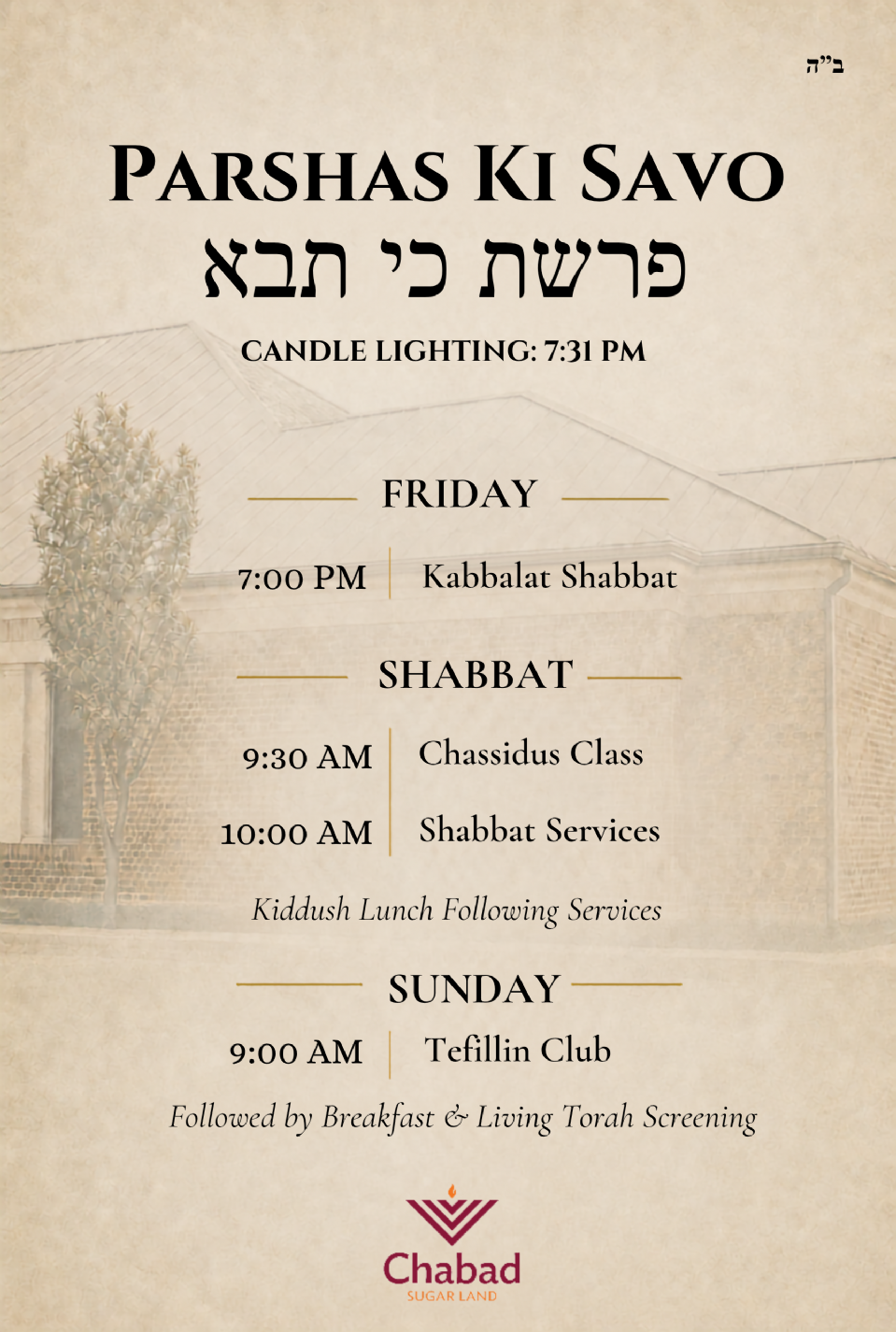
Candle Lighting Times for
Sugar Land, Texas:
Friday, Aug. 28
7:31 pm

Message from the Rabbi

Dear Friends,

Life doesn’t always go according to plan. We all face periods of disappointment, uncertainty, and pain. We naturally hope that things will get better, but Judaism asks us to stay engaged with the present.

In this week’s Torah portion, Moses describes the blessings that would come from following G-d’s commandments. He then describes the consequences that could follow when the Jewish people turned away from them. Our choices matter, even when we can’t control everything around us.

The Talmud tells us about two great sages, Rabbi Akiva and Nachum Ish-Gamzu. Nachum was famous for saying, “Gam zu letovah,” this too is for the best. He looked at every situation and saw the good within it.

Rabbi Akiva had a different attitude. He didn’t pretend that bad situations were good. He recognized that life could be painful and frightening. Still, he trusted that G-d could bring something good from difficult circumstances.

That gives us a different kind of optimism. We don’t have to pretend that everything is fine. We can recognize that something is difficult and still choose to do something good with the situation.

We can’t always choose what happens to us, but we can choose what kind of person we’ll be in response. A difficult day doesn’t excuse us from doing what’s right.

The good doesn’t always appear on its own. Sometimes we create it through the choices we make.

Rosh Hashanah is just around the corner. It’s a time to look honestly at the choices we’ve made and think about the person we want to be in the coming year. We don’t need to wait for a perfect moment to change. One good choice today can be the beginning of a better year.

Shabbat shalom,


Service Times:


Click here for the Weekly Encounter with the Rebbe story!


Parshat Ki Savo: How to Make Every day Meaningful.


The Fox in the Vineyard

From the Midrash

Published by Kehot Publication Society


A sly fox passed a lovely vineyard.

A tall, thick fence surrounded the vineyard on all sides. As the fox circled around the fence, he found a small hole in the fence, barely large enough for him to push his head through.

The fox could see what luscious grapes grew in the vineyard, and his mouth began to water.


But the hole was too small for him. So what did the sly fox do?

He fasted for three days, until he became so thin that he managed to slip through the hole.


Inside the vineyard, the fox began to eat to his heart’s content.


He grew bigger and fatter than ever before. Then he wanted to get out of the vineyard. But alas! The hole was too small again.


So what did he do? He fasted for three days again, and then just about managed to slip through the hole and out again.


Turning his head towards the vineyard, the poor fox said: “Vineyard, O vineyard! How lovely you look, and how lovely are your fruits and vines. But what good are you to me? just as I came to you, so I leave you . . .”


And so, our sages say, it is also with this world.


It is a beautiful world, but—in the words of King Solomon, the wisest of all men—just as man comes into this world emptyhanded, so he leaves it. Only the Torah he studied, the mitzvot he performed, and the good deeds he practiced are the real fruits which he can take with him.


Question:

I had planned to spend the High Holidays in Israel this year, but cancelled the trip because of the security situation.

Now that I’m staying in Australia, some friends have suggested that we take a road trip over the holiday period instead.  


The alternative is attending Rosh Hashanah and Yom Kippur services here. I usually go, but this year I’m nervous about that too. Jewish institutions have become potential targets, and seeing security guards and police outside the synagogue doesn’t reassure me. It reminds me that there is something to be afraid of.

Part of me thinks I should stop putting myself in situations of danger, take the road trip and forget about the whole thing this year.

But another part of me wonders whether I’m allowing fear to push me away from something important.

Help me think clearly about this.

Am I being sensibly cautious, or am I letting fear make my decisions for me?


Answer:

This isn’t only a question about thinking. It’s about feeling.

Because if this were purely rational, your road trip could be the riskiest activity of all.


Let's look at the statistics.


Since the establishment of the State of Israel, more than seven times as many people have been killed on Israel’s roads as civilians have been killed by terrorism. 


And here’s another surprising stat: Australia’s per-capita road-death rate has been higher than Israel’s in every year for the past decade. And yet an Aussie road trip feels perfectly safe, while an Israel trip feels dangerous. 


This is human nature. We ignore the dangers we are used to, while becoming fearful of the dangers that grab our attention. We know road accidents happen. But terrorism feels different. It is deliberate, dramatic and confronting.

Facts may put the danger in perspective, but they don’t make the fear go away. 


For that, we don’t need stats, we need security. 


The Hebrew word for security is bitachon. It is also the word for trust in G-d. That is not a coincidence. We cannot eliminate every possible danger. Our sense of security comes from knowing that our lives are in G-d’s hands.


Bitachon does not mean being irresponsible. We wear seatbelts, look both ways before crossing the road, and avoid unnecessary danger. Our synagogues have trained security guards, cameras, police support, and sensible procedures.

These safety measures are not a reason to stay away. They are there to make it safer for you to come.


They protect us on the outside. Bitachon gives us security on the inside. 


You cancelled one journey because of fear. Don’t allow fear to cancel the journey your soul needs to make.


Not a road trip. A walk to shul.


Good Shabbos,
Rabbi Moss


The new Daily Halacha Group is where a brief daily voice note - about one minute long - is shared by Rabbi Feigenson, highlighting a practical Jewish law.

The group has now begun learning the laws of Rosh Hashanah, offering a meaningful and accessible way to prepare for the upcoming holiday.

The project was started in memory of his father, Rabbi Peretz Feigenson OBM, who asked in his will that his children study one short section of Jewish law each day.

Join the Daily Halacha group and add one meaningful minute of Torah learning to your day.

Click here to join: https://chat.whatsapp.com/GUi3R2P5cOg1KsNQV4JrPm


Parshah Riddle:

Which two groups of people receive Maaser (Tithes)?


Answer to last week's riddle:

74

(Congrats to S. W. on the correct answer!)

Latest from www.ChabadSugarland.com

  
By the Numbers
16 Illuminating Facts About the Sun in Judaism
The closest star to Earth, it also holds a prominent place in Jewish literature, showing up again and again in Biblical stories and carrying layer upon layer of symbolism and meaning.
  
Your Questions
Are Deceased Parents Aware of the Happenings of Our Lives?
The Talmud discusses this question quite extensively.
  
Quiz
Take the Jewish Kings Quiz
Which king famously slew a giant with a slingshot?
  
Freeman Files
How to Find the King Inside Your Own Heart
What does it actually mean?

Parshah in a Nutshell


Parshat Ki Tavo

The name of the Parshah, "Ki Tavo," means "when you come," and it is found in Deuteronomy 26:1.

Moses instructs the people of Israel: When you enter the land that G‑d is giving to you as your eternal heritage, and you settle it and cultivate it, bring the first-ripened fruits (bikkurim) of your orchard to the Holy Temple, and declare your gratitude for all that G‑d has done for you.

Our Parshah also includes the laws of the tithes given to the Levites and to the poor, and detailed instructions on how to proclaim the blessings and the curses on Mount Gerizim and Mount Eival—as discussed in the beginning of the Parshah of Re’eh. Moses reminds the people that they are G‑d’s chosen people, and that they, in turn, have chosen G‑d.

The latter part of Ki Tavo consists of the Tochachah (“Rebuke”). After listing the blessings with which G‑d will reward the people when they follow the laws of the Torah, Moses gives a long, harsh account of the bad things—illness, famine, poverty and exile—that shall befall them if they abandon G‑d’s commandments.

Moses concludes by telling the people that only today, forty years after their birth as a people, have they attained “a heart to know, eyes to see and ears to hear.”

Learn: Ki Tavo in Depth
Browse: Ki Tavo Parshah Columnists
Prep: Devar Torah Q&A for Ki Tavo
Read: Haftarah in a Nutshell
Play: Ki Tavo Parshah Quiz


Today's Quote

That which emerges from your lips, you shall keep and do
— Deuteronomy 23:24

Chabad World News