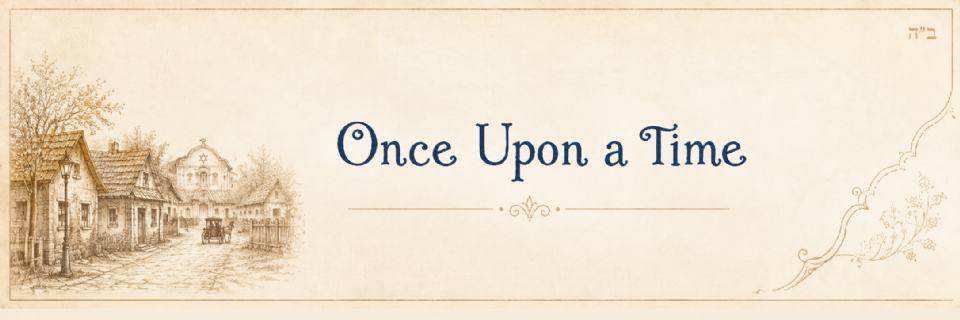
The Strange Gift That Shocked the Noblemen
ב"ה

The Chabad of Sugar Land Weekly Newsletter

Icon
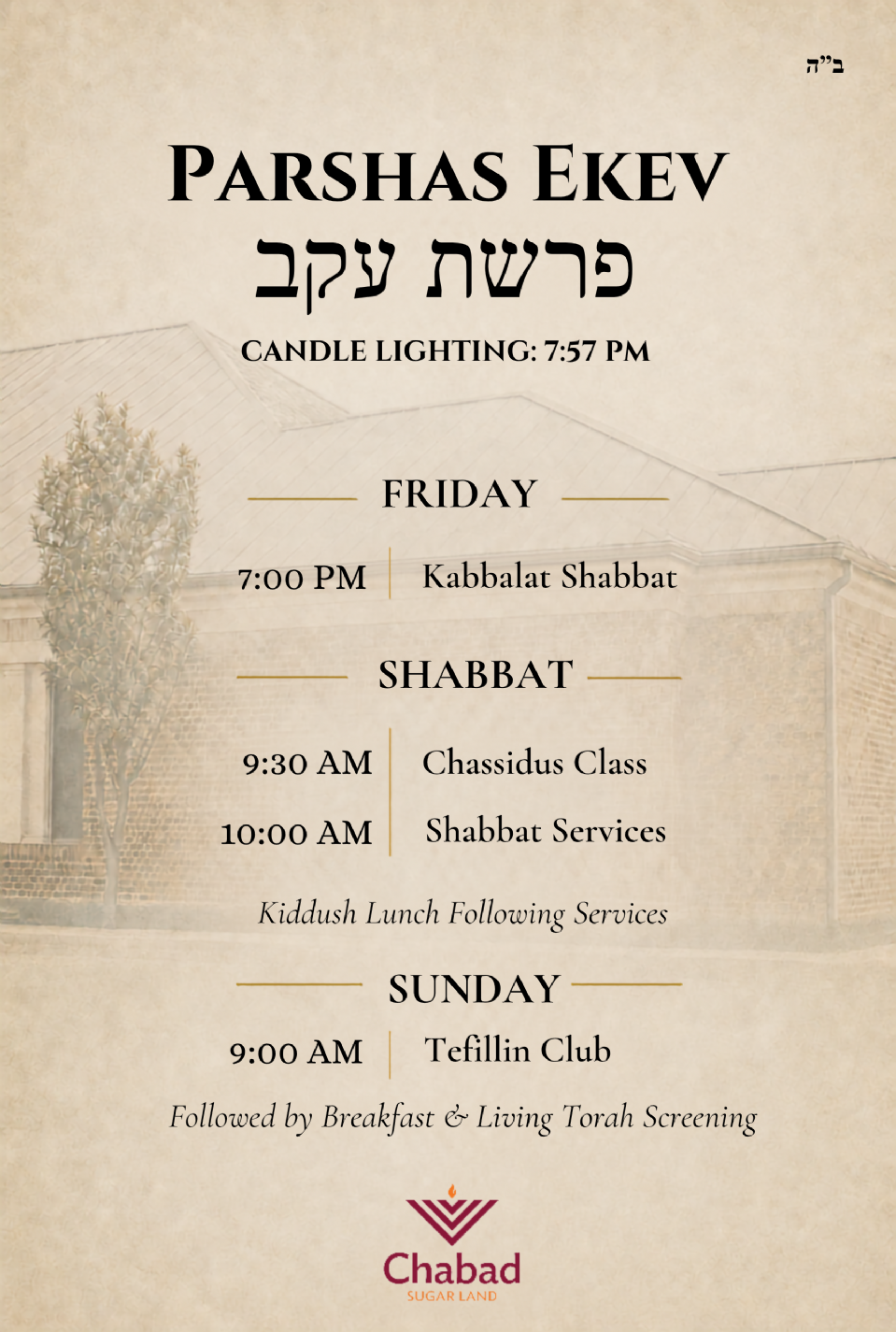
Candle Lighting Times for
Sugar Land, Texas:
Friday, Jul. 31
7:57 pm

Message from the Rabbi

Dear Friends,

In this week’s Torah portion, as Moses prepares the Jewish people to enter the Land of Israel, he reminds them that they are no longer the same nation that left Egypt. For forty years they had been cared for in the desert, receiving food, water, and protection without the responsibilities of ordinary life. Now it was time for them to mature and recognize the purpose behind their actions.

Moses teaches them that every mitzvah has value, even when we do not immediately see its impact. A small mitzvah may seem insignificant, but its true importance is measured by how G-d sees it, not only by our limited perspective.

As we grow in our own Jewish journeys, we discover that mitzvot are not simply rules imposed upon us. They are opportunities to strengthen our connection with G-d and bring more goodness into the world. Like children who eventually appreciate the wisdom of their parents, we come to recognize the meaning behind the guidance we have been given.

True spiritual growth comes when we move beyond simply doing what we are told and begin to appreciate the beauty and meaning behind it. That lifelong process of growth brings us closer to G-d and prepares us for the time when the full purpose of our efforts will be revealed, with the coming of Moshiach!

Shabbat shalom,


Service Times:

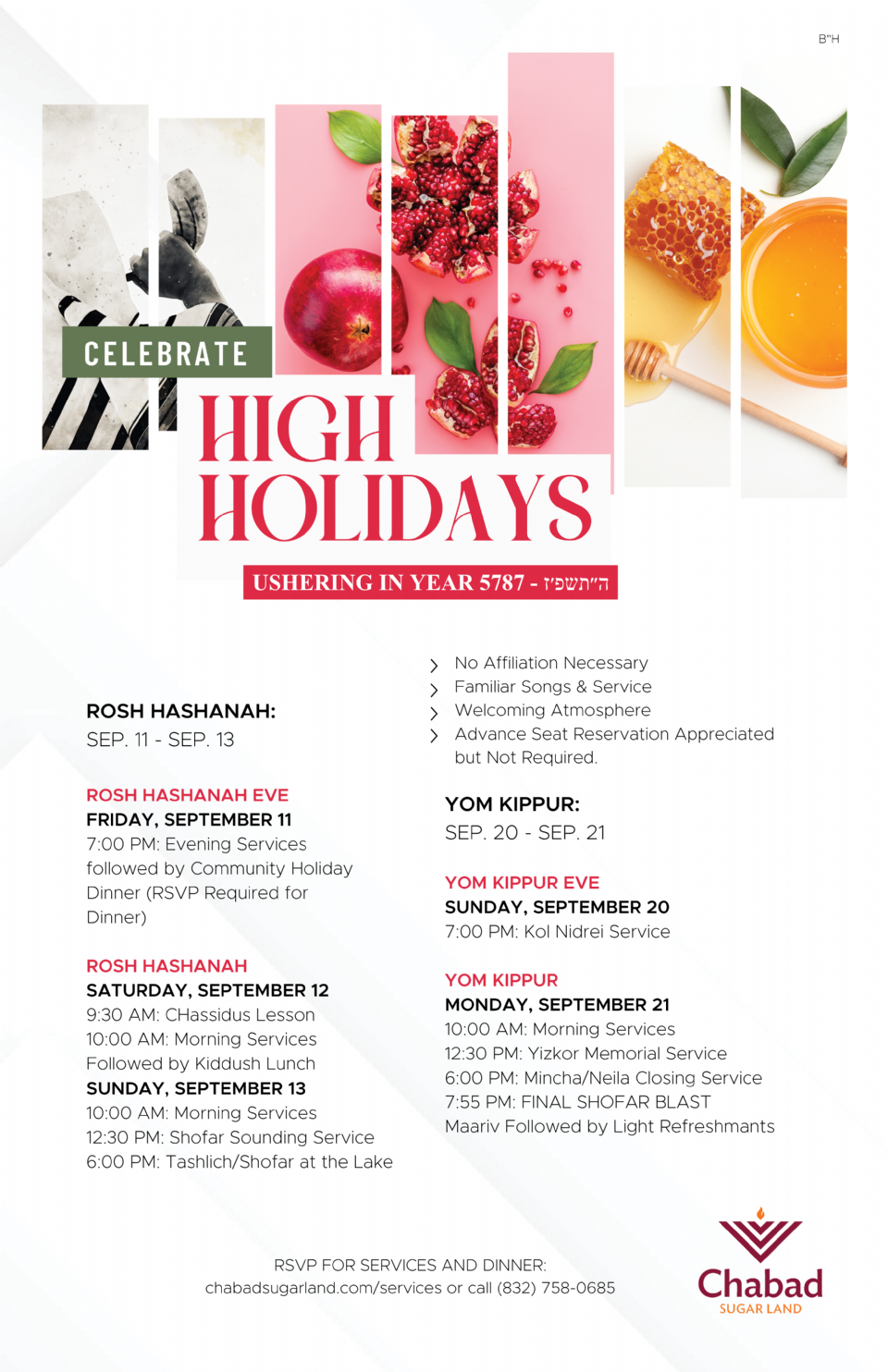
It's High Time

Please click here to make High Holiday seat and/or Rosh Hashanah Eve Dinner Reservations.


Weekly Parsha Video

Ekev: How Does One Ignite Their Emotions?

Click here to watch!


Click here for the Weekly Encounter with the Rebbe story!


Weekly Story


In the days of the Baal Shem Tov, there lived a G‑d-fearing Torah scholar who earned his livelihood as an innkeeper. He leased a tavern on one of the estates of one Count Potozki.


Fortune did not smile kindly on him. For two years, he was not able to pay his rent. The count warned him that if he did not pay off his debt in the third year, he and his family would soon taste the vengeance that was common among the local squires in those days.

The entire household of the poor man was plunged into misery. There seemed to be no hope for them.


One day, his good wife said: “Listen, my dear husband, I’ve heard that not too far from here, there lives a holy rabbi who has helped many people in distress. His name is the Baal Shem Tov. My advice to you is that you travel to him and tell him all about our situation.

Do exactly what he tells you to do, and G‑d will surely help us through this.”


At first, the innkeeper refused. He was no chassid, and he did not understand how the Baal Shem Tov could help. But the wife persisted in her request, until eventually he agreed to go. He set out with a heavy heart to the Baal Shem Tov, to whom he described his terrible plight.


The Baal Shem Tov advised him: “Go for a stroll in the street on Sunday morning, and when you are approached by a villager who offers to sell you something, buy it at once. Take absolutely no notice of what the object is, or whether it is worth the price the villager asks for it. Then come to visit me again, and I will tell you what to do with your purchase.”


This sounded like a bitter jest to the poor man. He had never been one to believe in wonders and miracles. He had no intention of carrying out the strange instructions of the Baal Shem Tov.


When he came home, his wife asked him what the tzadik advised him to do. When he told her, she insisted that he do exactly what the tzadik advised.


When Sunday morning came, she gently encouraged him to go for a stroll.

Immediately, the man saw the words of the tzaddik coming to life—a villager approached him and offered to sell him the fleece of a sheep. He asked how much it would cost, and the villager answered, “One gold ruble.”


So astonished was the man at what was happening that without a second thought, he handed over the last gold ruble he owned and took the fleece.


Immediately, the man regretted the transaction.

He went home vexed and disgruntled, and burst out to his wife: “Look what I’ve earned by listening to your advice. What on earth can I possibly do with a fleece? And I went and spent my last gold ruble on it! What will become of us now?”


His wife answered him, “Don’t you recognize that the Baal Shem Tov is a man of G‑d? Haven’t you seen with your own eyes that no word of his is said in vain? Why don’t you go back and visit the holy man again, just as he told you to. Surely G‑d will come to our aid.”


Her husband had no choice, so he went. The Baal Shem Tov heard his account of what had transpired with the villager and said: “My son, you did the right thing by buying the fleece. Now, take note of what I tell you. In a few days, a great number of nobles will be coming to visit your count for his birthday. Each one will bring a gift. You go along on the same day and present him with the fleece as a birthday gift.”


Was the Baal Shem Tov making fun of him? he thought. What a preposterous suggestion! How could he do a thing like that? He came home and let his wife know how he felt.


His wife, however, was a woman of faith. “Does it not say in the holy books that you should not try to figure out things that are beyond the reach of our humble mortal understanding? All you should do is carry out whatever the Baal Shem Tov told you to do and be strong in your faith in G‑d who works through the tzadik,” she said.


On the day of the count’s birthday party, the innkeeper’s wife bustled him out of the house with the fleece over his shoulder. His heart was heavy with foreboding and his steps trembled with terror as he made his way to the count’s castle.

The many elaborate carriages surrounding the palatial home bespoke the nobility inside celebrating the count’s birthday.


The poor innkeeper paused at the door, not knowing what to do. Should he go inside and garner the wrath of his landlord, or turn back and go home? He had just about decided to go home when the massive door opened and one of the count’s guards sized him up and shouted: “Jew! What are you carrying? Did you come here to bring a present to the count as well?”


In his bewilderment, he held out the fleece. The guard grabbed it from his hand and hurried inside with it. He showed it to the count and all the assembled guests.

“This,” he announced, “is a gift from the Jew who rents the inn on the count’s estate!”


The count was furious! He had the Jew thrown into his prison, while contemplating this riddle.


“Can it be that this man would have the nerve to insult me in the middle of my festivities?” he questioned, as if speaking to himself. “Surely no man hands himself over to be killed.”


The count rose from the table, still holding the fleece, and secluded himself in his room. Perhaps there was something special about this strange gift.

As he gazed upon it, he saw what appeared to be letters in the fleece. Soon he was able to make out his name, his father’s name, and the year, the month and the day on which he was born! He was so overawed by this wondrous sight and so filled with joy!


He strode back to the reception hall and went from table to table with his prized possession, asking the guests whether they thought this was the work of a gifted craftsman or whether it was an uncanny product of nature. They were all of one opinion—no craftsman in the world could contrive such a wonder.

It must be a miracle from Heaven.


The count immediately had the trembling innkeeper released and brought before him. From all sides he was asked the same question—“Where did you get a hold of such a fleece?”


The poor fellow was now convinced that death was indeed near at hand. In his desperation, he hurled himself at the feet of the count and with bitter tears told him his whole sad story.


All the nobles listened attentively, and when he fell silent, the count spoke up: “Do not fear, my good man, for the holy man sent you here for a blessing.”

He then showed him the wonder of the fleece that he had brought. The visiting nobles meanwhile decided that the count should make himself a fur hat out of this fleece. Every year thereafter, on his birthday, he should wear it and present the Jew with special gifts.


To start the tradition, all those present gave him gifts of gold and silver. The count announced that he would forego the entire debt of the preceding years.

The innkeeper was escorted from the palace with due pomp, and from that day till the end of his years, he prospered in all his ways.

(Adapted from Sippurei Chassidim, Parshat Toldot)


What looks senseless from our limited perspective may be the very path through which G-d sends the blessing.


Parsha Riddle!


From Heaven I came at break of day,
But in the heat I’d melt away.
Each gathered the same, both great and small,
Yet I could taste like anything at all.

What am I?


Think you know it? Reply with your answer!


The answer will appear in next week’s newsletter.


Answer to last week's riddle:

The Shema

Congrats to B.F. on the correct answer!


Ask The Rabbi: Weekly Q&A


Question:

It was so painful to leave the cemetery after my mother's funeral. In between my tears, I noticed something a little strange. The Rabbi, as he was walking back to his car, bent over, pulled some grass off the floor and threw it over his shoulder. I wasn’t just seeing things. There was something deliberate there. What's the meaning behind this? Is this some superstition? 


Answer:

Walking away from a funeral can be one of the hardest moments.


There's a sense that we're leaving a loved one behind. The finality is hard, stark, and painful. They're gone and we'll never see them again. 


But this is not the case. We will see them again. 


An essential belief of Judaism is that at the end of days the dead will rise again. All those beautiful souls that we've lost will come back, and we'll be reunited to enjoy a future world where death is vanquished, pain is erased and tears are wiped away from all faces. 


This is not a fringe mystical idea. Resurrection of the dead is one of Judaism’s fundamental beliefs. And yet, it’s a hard one for us to get our head around. So far, we haven't witnessed anyone coming back from the dead, and imagining it happening en masse may seem a little far-fetched. 


But the truth is, we have seen the dead come back to life. It happens all around us. 


Every blade of grass is a resurrection. For a plant to grow, the seed decays and disappears in the ground. Then, just as the seed seems to be lost, a root sprouts. From there, new life emerges, as a seedling appears through the soil. 


Resurrection sounds supernatural. But we see it in nature itself.


That's the reason for the custom of throwing grass over our shoulder as we walk away from a funeral. On the one hand, we are leaving the cemetery and returning to the land of the living. But as we do that, over our shoulder, we send a message: burial is planting.

Death is not the end of the story. We are sad to walk away. But as the grass reminds us, the goodbye is not forever. 


Good Shabbos,
Rabbi Moss

Upcoming Events

Shabbat Services
Shabbat, Aug. 1, 2026 - 10:00 am
At the Chabad Center in Sugar Land, we offer Shabbat and holiday services that are joyous, engaging and uplifting.
Tefillin and Breakfast
Sunday, Aug. 2, 2026 - 9:00 am
Start the week off right! Shacharit prayers, a gourmet bagel breakfast and screening of the weekly Living Torah video

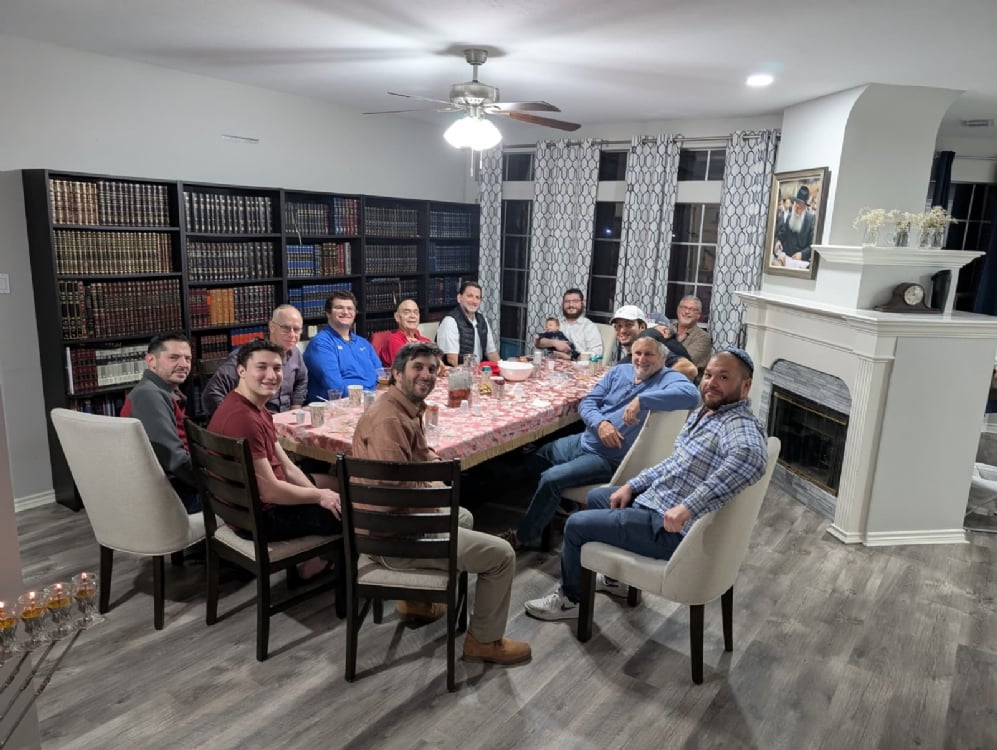
Recent Photos

Latest from www.ChabadSugarland.com

  
By the Numbers
14 Simple and Surprising Things Jews Do With Fire
Fire enhances life in a great many ways, while simultaneously being one of the most dangerous substances on earth.
  
Your Questions
Why Does a Husband Stay Home During the First Year?
“When a man takes a new wife, he shall not go out in the army…”
  
Voices
My Friend Sami Rohr, the Torah Scholar
Honoring a patron of Jewish life on his yahrzeit, 17 Menachem Av.
  
Freeman Files
Heels Over Head
Every mitzvah, even a simple rule that we would have figured out on our own, is part of a covenant and connection that entirely transcends our limited reality.

Parshah in a Nutshell


Parshat Eikev

The name of the Parshah, "Eikev," means "because," and it is found in Deuteronomy 7:12.

In the Parshah of Eikev (“Because”), Moses continues his closing address to the children of Israel, promising them that if they will fulfill the commandments (mitzvot) of the Torah, they will prosper in the Land they are about to conquer and settle in keeping with G‑d’s promise to their forefathers.

Moses also rebukes them for their failings in their first generation as a people, recalling their worship of the Golden Calf, the rebellion of Korach, the sin of the spies, their angering of G‑d at Taveirah, Massah and Kivrot Hataavah (“The Graves of Lust”). “You have been rebellious against G‑d,” he says to them, “since the day I knew you.” But he also speaks of G‑d’s forgiveness of their sins, and the Second Tablets which G‑d inscribed and gave to them following their repentance.

Their forty years in the desert, says Moses to the people, during which G‑d sustained them with daily manna from heaven, was to teach them “that man does not live on bread alone, but by the utterance of G‑d’s mouth does man live.”

Moses describes the land they are about to enter as “flowing with milk and honey,” blessed with the “ seven kinds” (wheat, barley, grapevines, figs, pomegranates, olive oil and dates), and as the place that is the focus of G‑d’s providence of His world. He commands them to destroy the idols of the land’s former masters, and to beware lest they become haughty and begin to believe that “my power and the might of my hand have gotten me this wealth.”

A key passage in our Parshah is the second chapter of the Shema, which repeats the fundamental mitzvot enumerated in the Shema’s first chapter, and describes the rewards of fulfilling G‑d’s commandments and the adverse results (famine and exile) of their neglect. It is also the source of the precept of prayer, and includes a reference to the resurrection of the dead in the messianic age.

Learn: Eikev in Depth
Browse: Eikev Parshah Columnists
Prep: Devar Torah Q&A for Eikev
 Read: Haftarah in a Nutshell
Play: Eikev Parshah Quiz


Today's Quote

Like a burning candle from which many candles are lit yet its own light is not diminished, so, too, Moses lost nothing that was his
— Midrash rabbah

Chabad World News