As we begin the book of Deuteronomy, Moses delivers his final message to the Jewish people. He looks back on the ups and downs of the previous forty years and speaks honestly about the mistakes they made. Yet before doing so, he made sure they knew where they stood with him.
Moses had just led the Jewish people to victory over the powerful kings Sichon and Og, helping secure land that would become part of their future home. His actions showed that he was completely devoted to their wellbeing.
When he later spoke about their shortcomings, his words were heard because they came from someone who had already shown his love and commitment.
There’s an important lesson here. Most people can accept criticism when they know it comes from someone who truly cares about them. We all respond better when we feel respected and valued.
That message is especially fitting as we enter the Jewish month of Av. Next week we will mark Tisha B'Av and mourn the destruction of the Holy Temple. Our sages teach that the Second Temple was lost because of needless
hatred between Jews. If division helped bring about its destruction, then kindness and stronger relationships are what can help bring healing.
We cannot fix every problem in the world, but we can choose how we treat the people around us. The Torah reminds us that these are often the very things that have the greatest impact.
Shabbat shalom,
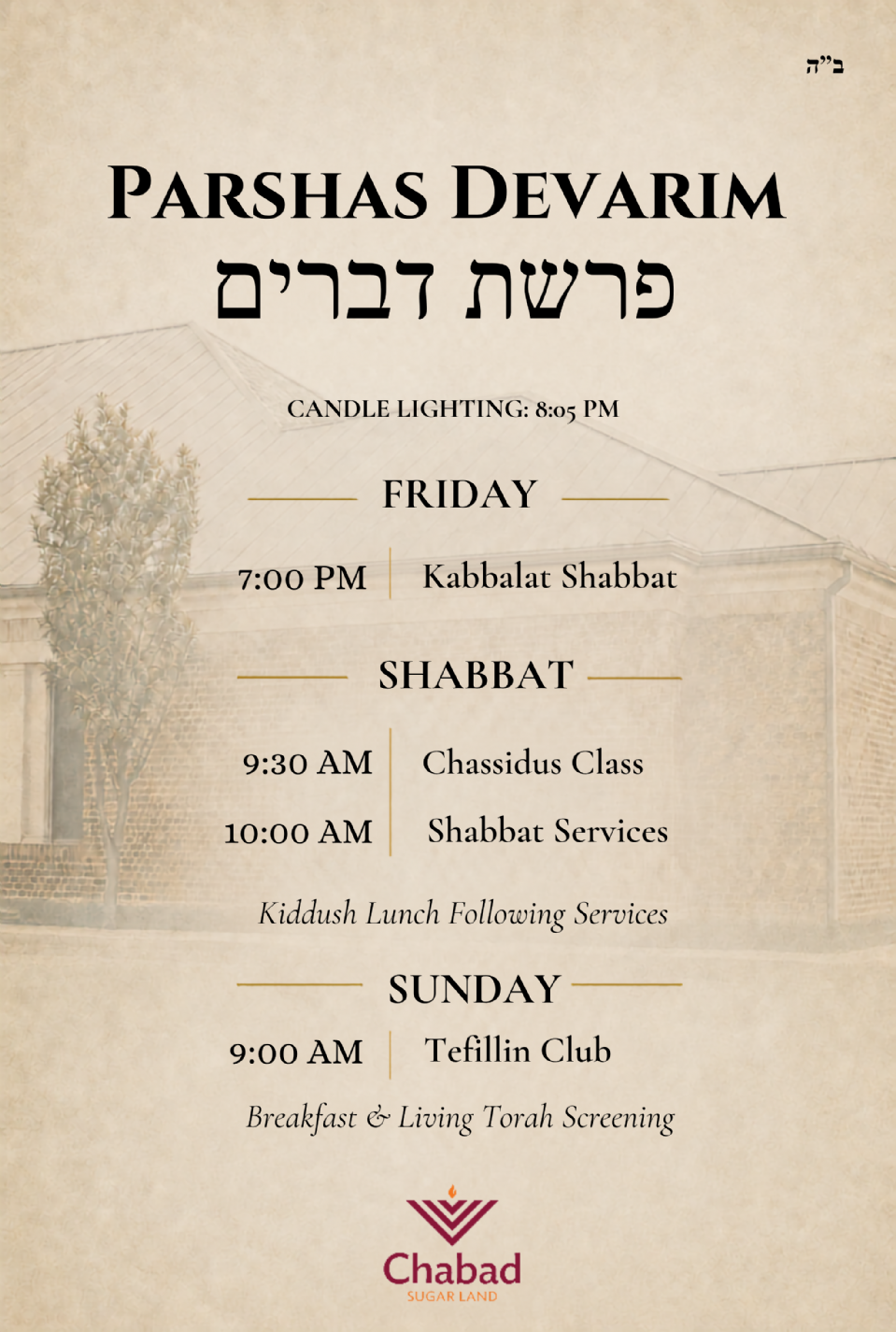
Service Times:
Tisha B'Av
Tisha B’Av, the 9th day of the month of Av - this year Wed. July 22 at sundown through Thu. July 23 after nightfall - is the saddest day on the Jewish calendar, on which we fast, deprive ourselves and pray.
It is the culmination of the Three Weeks, a period of time during which we mark the destruction of the Holy Temple in Jerusalem. Please click
here for the complete overview of the history and laws of this day.
The fast begins Wednesday evening at 8:21 PM, and concludes Thursday evening at 8:47 PM.
Chabad of Sugar Land will be having evening service followed by the traditional recitation of the Scroll of Eicha - lamentations, Wed. evening, 07/22, 8:45 PM.
It is by no accident that Scripture refers to this day as a mo’ed, a holiday, and Tachanun (prayer of repentance) is not said today. May the time soon come when we look back with the clarity of hindsight to see
how all our suffering was but a prelude to happiness and goodness, with the coming of Moshiach. Amen!
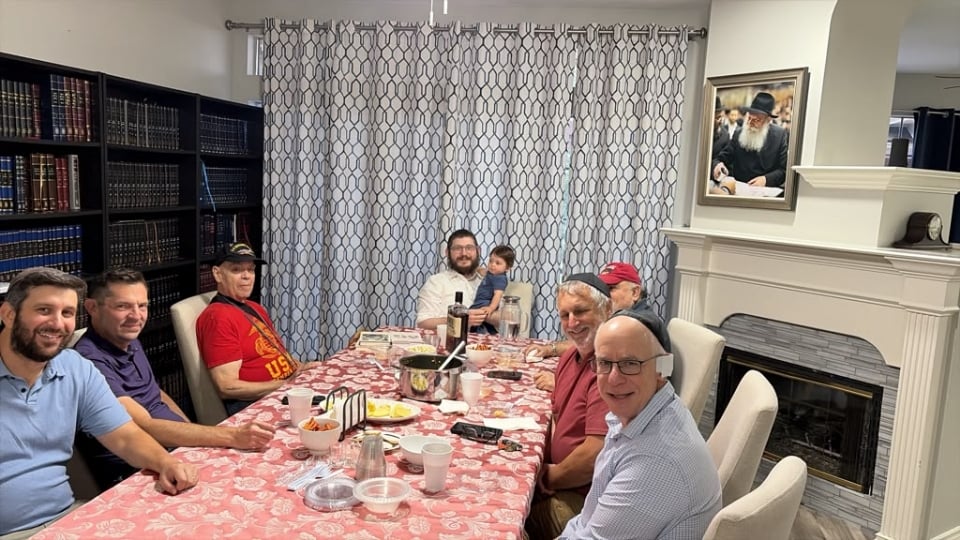
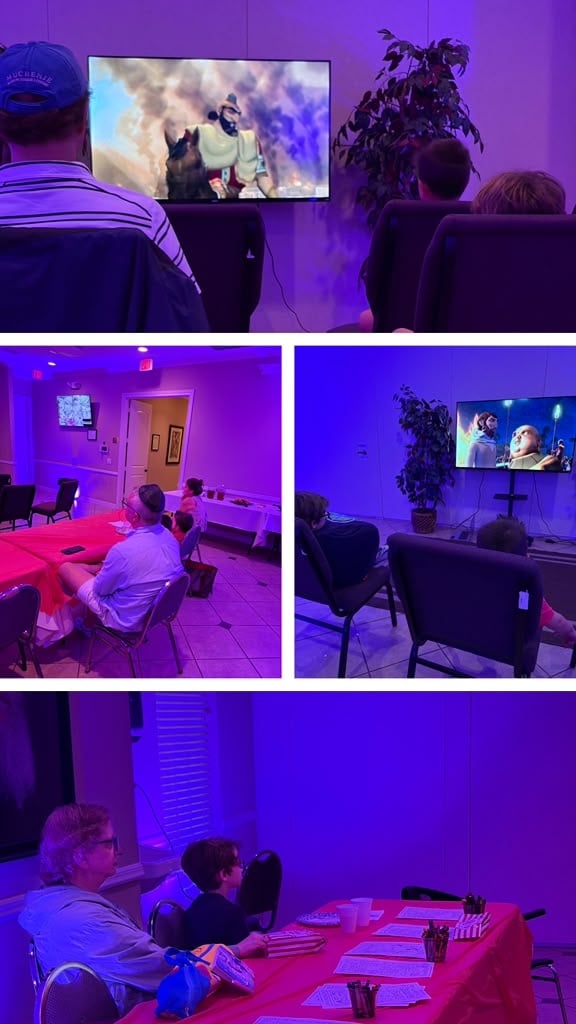
Pictures of the Week:
Top: Congrats S. Chapman on the move! No better way to inaugurate the new place than by putting up some Mezuzot!
Middle: Weekly Men's Study & Stew!
Bottom: Jewish Movie Night at Chabad this past Sunday! Part two of the Sunday FunSeries - stay tuned for part three coming Aug. 9: an exciting Bubble Show!
The Holy Temple Comes to Life
What would it feel like to step inside the Beis Hamikdash and experience its meaning firsthand?
Join us for Heaven on Earth, an immersive multimedia Dinner & Discussion that vividly brings the Holy Temple to life and reveals timeless lessons for renewal, growth, and purpose!
Taking place Monday, July 20 at 7:00 PM, at Chabad of Sugar Land. A dairy buffet dinner will be served.
Contact Bas Sheva at (949) 527 - 2847 for more info.
Weekly Story
R’ Alexander, a righteous and ardent chassid of the Alter Rebbe, was preparing for a business trip when the Rebbe made an unusual request:
“When you are finished with your business, please stop at this nearby town.”
He had no idea why or what he was supposed to do there, but R’ Alexander trusted the Rebbe and agreed to the task.
As soon as he arrived in the town, he noticed that something was different. The Jews there were dressed in the modern style of clothing, influenced by the winds of enlightenment blowing from the West.
He felt uneasy about spending Shabbat in an unfamiliar town, but found lodging at the only kosher establishment, owned by a woman named Hindel. She promised to take care of his needs for Shabbat.
During Shabbat prayers and meals, R’ Alexander shared words of Torah and chassidic melodies that deeply touched those in attendance. He still didn't understand why the Rebbe had sent him there until he saw a young boy at the end of the table, his eyes wide open, taking it all in.
Then he heard Hindel sobbing in the corner.
He approached her and asked why she was crying. She explained that when her father, who had been the town rabbi, was alive, they used to have a beautiful Shabbat experience just like this every week.
After his passing, the town had lost its Jewish heart. Now, her husband was often away for Shabbat. Her son rarely experienced such beauty and meaning and she was worried about his Jewish education. She started to cry again.
R' Alexander had an idea.
He offered to take her son back with him to the Alter
Rebbe in Liozno to be educated in the inspiring ways of Chassidism. After hearing his descriptions of the warm Jewish life of the Chassidic community and the greatness of the Alter Rebbe, she agreed to send him.
Now R' Alexander understood his mission. The Rebbe had sent him to this town because there was a special soul there that was thirsting for Yiddishkeit.
The young boy grew up to be one of the Alter Rebbe’s most illustrious students, Reb Peretz Chein, the progenitor of a large family of rabbis and communal leaders (including our very own Bas Sheva!) many of whom continue to bear his name.
(Sippurei Mofet: Baal Hatanya, page 225)
Sometimes we may not understand why we are sent on a particular mission, but we must find the hidden purpose. Who knows, maybe a small act of kindness can lead to something great…
Parsha Riddle!
Moses recounts the appointment of judges for the Jewish people.
Who's idea was it orginally to set up the civil court system?
Think you know it? Reply with your answer!
The answer will appear in next week’s newsletter.
Answer to last week's riddle:
A "Neder", an Oath.
Ask The Rabbi: Weekly Q&A
Question:
I've recently started putting on tefillin again, and it feels really good. I've noticed something I never saw before, that on one side of the head tefillin there's a letter Shin, and then on the other side there's another letter Shin, but one of them is normal with three legs and the other one has four legs. What’s that about?
Answer:
Well spotted!
Those two Shins on the Tefillin have profound significance. The Zohar explains the depth behind the unusual four-legged Shin.
We just need to do some maths to work it out.
Every letter in the Hebrew alphabet has a numerical value. The value of Shin is 300. So two Shins add up to 600.
Then, if you place one Shin next to the other, they spell the word Sheish, which is Hebrew for the number six.
So we have 600 and 6.
Now, if you count the legs on the two Shins, there is the three-legged one and the four-legged one, all together seven legs.
We are now left with 600, 6 and 7.
600 + 6 + 7 = 613
613 is the total number of commandments in the Torah. It is no coincidence that the Shin combination adds up to that number. Tefillin is one mitzvah that represents them all.
Tefillin is like a miniature version of the whole Torah.
Tefillin bind our thoughts and actions to G-d. The head represents how we think, the arm how we act. Between them, they symbolise a life devoted to every mitzvah, not just one.
Judaism is about finding holiness in the everyday and bringing G-d down into our physical world. The daily practice of putting on Tefillin illustrates this perfectly. A black leather box becomes sacred. Your arm and head become holy. Your daily routine becomes elevated.
That's why Tefillin are so important. They are a gateway mitzvah. Put them on daily and wrap yourself in the whole Torah, from your head down to your shins.
Freeman Files G‑d
Is Not a Thing The other day I realized that I hadn't seen G-d in quite a while -- probably not since childhood... Where did I misplace Him?
By the Numbers 11
Things Jews Do to Remember the Holy Temple As we mark the Nine Days, let’s explore 11 ways Jews remember the Temple, its rituals, and its destruction throughout the year.
Podcasts Full
Circle in the Arctic Circle When this Air Force chaplain was sent to remote Greenland, he knew it was G-d's will. He also knew he had a lot of preparing to do.
The name of the Parshah, "Devarim," means "the words" and it is found in Deuteronomy 1:1.
On the first of Shevat (thirty-seven days before his passing), Moses begins his repetition of the Torah to the assembled children of Israel, reviewing the events that occurred and the laws that were given in the course of their forty-year journey from Egypt to Sinai to the Promised Land, rebuking the people for their failings and iniquities, and enjoining them to keep the Torah and observe its commandments in the land that G‑d is giving them as an eternal heritage, into which they shall cross after his death.
Moses recalls his appointment of judges and magistrates to ease his burden of meting out justice to the people and teaching them the word of G‑d; the journey from Sinai through the great and fearsome desert; the sending of the spies and the people’s subsequent spurning of the Promised Land, so that G‑d decreed that the entire generation of the Exodus would die out in the desert. “Also against me,” says Moses, “was G‑d angry for your sake, saying: You, too, shall not go in there.”
Moses also recounts some more recent events: the refusal of the nations of Moab and Ammon to allow the Israelites to pass through their countries; the wars against the Emorite kings Sichon and Og, and the settlement of their lands by the tribes of Reuben and Gad and part of the tribe of Manasseh; and Moses’ message to his successor, Joshua, who will take the people into the Land and lead them in the battles for its conquest: “Fear them not, for the L‑rd your G‑d, He shall fight for you.”
This email is sent from Chabad of Sugar Land. We'd love to stay in touch with you, but if you wish to be unsubscribed from this list please click here, or click here to manage your subscriptions.





 Contact Bas Sheva at (949) 527 - 2847 for more info.