The Shabbat Man
ב"ה

The Chabad of Sugar Land Weekly Newsletter

Icon
Candle Lighting Times for
Sugar Land, Texas:
Friday, Aug. 7
7:52 pm

Message from the Rabbi

Dear Friends,

One of the biggest challenges in teaching or mentoring is knowing how much to share. If you overwhelm someone with too much information, they may miss the message entirely. Good teachers understand that people grow step by step, and lessons need to match where the student is at that moment.

This week's Torah portion, however, reminds us that there are exceptions. The Torah commands that when a servant completes years of service, the employer should not simply pay what is owed, but send them off with generous gifts. The Torah even describes this generosity as an act of tzedakah, giving beyond obligation. As someone begins a new chapter in life, they deserve more than the minimum.

The same idea applies to the relationships that shape us. Most of the time, we teach gradually. But when someone is about to graduate or move on to the next stage of life, that’s the moment to hold nothing back. Share your values, your wisdom, your experiences, and your encouragement. You may not get another opportunity.

Sometimes we have only one meaningful conversation with another person. Rather than assuming they can only absorb a little, the Torah encourages us to be generous with our time and our attention. You never know which word of inspiration will stay with someone for the rest of their life.

Shabbat shalom,


Service Times:

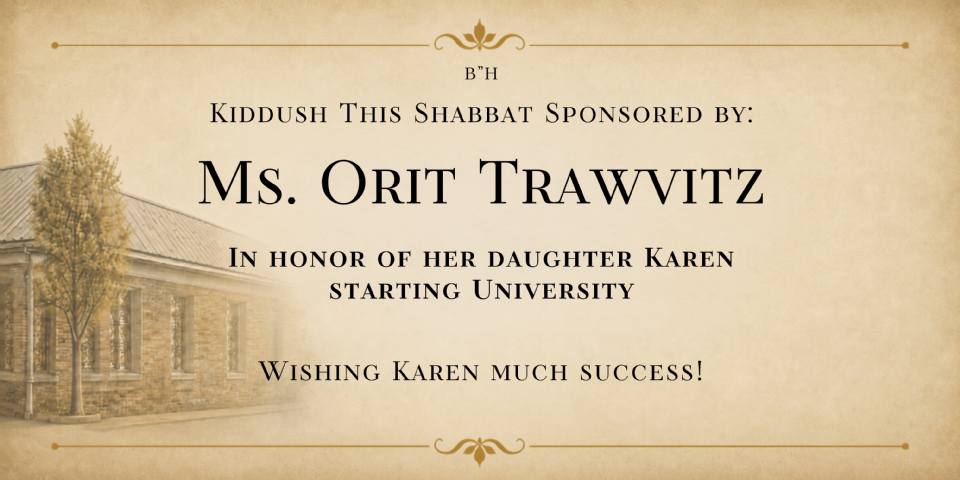
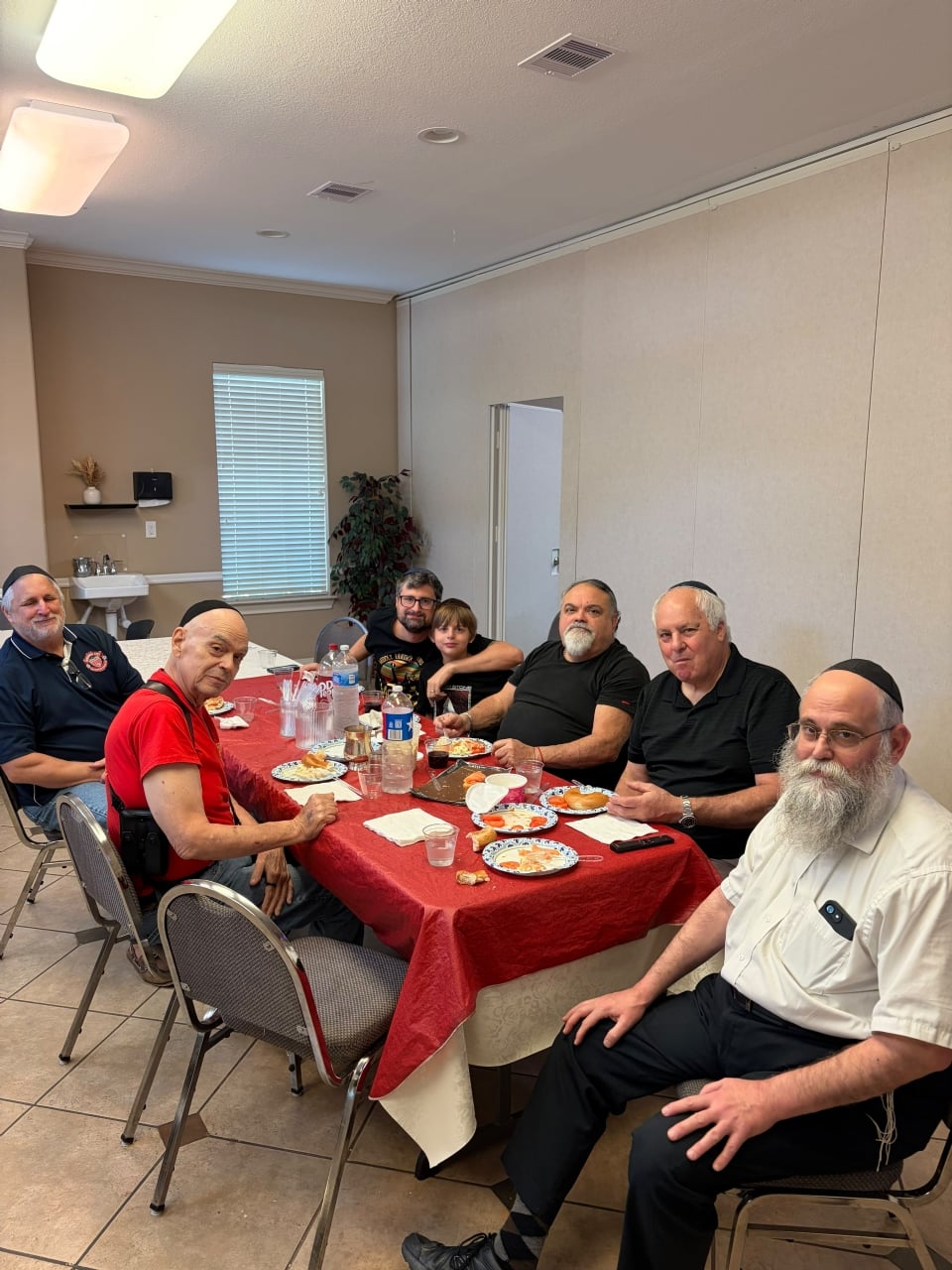
Kiddush Sponsored By:


Click here for the Weekly Encounter with the Rebbe story!

Weekly Parsha Video

Parshat Re'eh: Am I Kosher?


Ask The Rabbi: Weekly Q&A


Question:

If G-d loves us unconditionally, why does Judaism have so many conditions? Keep the laws and you’re good, don’t keep them and you’re in trouble. What type of unconditional love is that?


Answer:

My kids ask me the same question:

If you love me for who I am, why do I have to go to school?

You love me no matter what, so do I really need to clean up after myself?

I am your child and always will be. Even if I speak back to you disrespectfully, ignore you when you tell me it’s bedtime and leave my shoes lying around in the middle of the hallway.

So why do you demand so much of me? Why do these things matter if you love me unconditionally?


The answer is obvious. Demands and unconditional love are not mutually exclusive. In fact, they go hand in hand. I demand from you because I love you. I have expectations because I care. I want to see you become the best person you can be.


Unconditional love means the relationship is unbreakable. It doesn’t mean your behaviour is inconsequential.

And yet, I will love you however you turn out. Because you are my child.


G-d’s commandments are not conditions to earn G-d’s love.

They are expressions of that love. As the Midrash says, the mitzvos were given to refine people. Our loving Parent wants to see us thrive.


And if we don’t, He still loves us. The way back is always open. That’s why every year we have the High Holidays, days of repentance and renewal. We can fix what went wrong and start over.


Deep down, my kids know why they have to keep the rules. Even if they complain about it, they want to do the right thing.

And even as I trip over their shoes in the hallway, I smile and think how much I love them.


And hope they’ll put them away next time.


Good Shabbos,
Rabbi Moss


Source:
Bereishis Rabbah 44:1


Weekly Story


The Shabbat Man

By Shimon Posner

Some called him Reverend Abrahamson. Others called him Cantor. My father called him Chazzan and bristled at the other names: evidently those other names were too cold and distant to identify our Chazzan.


However you would call him, Chazzan Abrahamson was the oldest person I knew, at least he seemed that way, with a small, pure-white moustache and a head of snow-white hair to match.


He was small and walked with slow, deliberate steps. His wife would always walk with him to synagogue, even Friday nights when no other women came for services. She was prim but more quick-footed and I sensed even then that she was somehow protecting him.


He was from Europe, with genteel, old-world manners. Delicate and compact in speech and deed and presumably in thought also, he was unfailingly polite.


yekke, such people were called in the old country.


He wore an old-style cantor's hat, black, silken, rising six inches above the head and crowned with a somber pom-pom which bemused me even then. He draped his tallit gently over his shoulders.


None of us children had much to do with him. Nor do I remember many adults having much conversation with him beyond respectful salutation.


He would stand on the platform in front of the Ark when the Torah was being taken out. He led the congregation in the Shema, reciting each word forcefully, precisely, dramatically and finishing off the sacred phrase with a flourish: Echad! Looking back, I can now identify what I noticed then: there was also a controlled emotion.


A number of years ago, I heard that he had been a diamond cutter when he first came to Nashville from the old country, arriving in the Twenties, I believe. He was looking for work and even with a sharp eye for stones and the steady hand of youth he had a hard time landing a job.


Finally someone made him an offer.


He would work eleven hours a day, six days a week, Sunday off.

But I don't work on Shabbat, the then-young man protested. If you don't work Shabbat, replied the only person who had offered him a job, then you don't work Monday.


The genteel personality, so reminiscent of Western European finery, so appreciated in the South, looked at his would-be employer:

"I will die in the streets of hunger before I work on Shabbat."


It wasn't until decades later that he became Chazzan, cantor, of my father's synagogue. Personality, I guess, is only so deep, beneath that is primordial essence. When you're not hostage to your personality, the mores around you or anything else, then you can be true to your essence.


The Chazzan passed on nearly twenty-five years ago. Many a Shabbat it is I who now stand before the congregation and the Ark, holding the Torah and leading the  Shema.


I hope that somehow, with something beyond me, I am conveying something more than the tune. Something the Chazzan conveyed without ever articulating it.

That nicety should be a proper setting for the stone but never overpower it. That polish should enhance the metal, but never make you doubt the metal. That underneath it all must burn a fire in the belly and a passion of the spirit that niceties can never smother.

That enveloped in a silken personality must be an iron will that in the face of multiplicity, division, even duplicity, the cry will ring clear, precise and dramatic: Hashem Echad! G‑d is One.


Parsha Riddle!


Three times a year we make our way,
To the place Hashem chose to stay.
Each comes around at its appointed time,
Can you name all three in this rhyme?


Think you know it? Reply with your answer!


The answer will appear in next week’s newsletter.


Answer to last week's riddle:

The Daily Manna

Latest from www.ChabadSugarland.com

  
By the Numbers
Extreme Judaism! 12 Facts About Jewish Life in the Polar Regions
While there isn’t a synagogue at the North Pole (yet!), there has been, and there still is, a Jewish presence not far from the Arctic and Antarctic Circles.
  
Your Questions
Why Do We Write Hebrew from Right to Left?
Learn the answer to this simple-seeming question in the light of history, Jewish law, and kabbalah.
  
Quiz
Take the Jewish Songs Quiz
Who composed the common tune for “Eishet Chayil”?
  
Freeman Files
What Is a Yetzer Hara and the Secret of Getting Rid of It?
The yetzer hara is an instinctive impulse for self-gratification (bad), embodied by the emotional responses of the beast within you.

Parshah in a Nutshell


Parshat Re'eh

The name of the Parshah, "Re'eh," means "See," and it is found in Deuteronomy 11:26.

“See,” says Moses to the people of Israel, “I place before you today a blessing and a curse”—the blessing that will come when they fulfill G‑d’s commandments, and the curse if they abandon them. These should be proclaimed on Mount Gerizim and Mount Ebal when the people cross over into the Holy Land.

A Temple should be established in "the place that G‑d will choose to make dwell His name there,” where the people should bring their sacrifices to Him; it is forbidden to make offerings to G‑d in any other place. It is permitted to slaughter animals elsewhere, not as a sacrifice but to eat their meat; the blood (which in the Temple is poured upon the altar), however, may not be eaten.

A false prophet, or one who entices others to worship idols, should be put to death; an idolatrous city must be destroyed. The identifying signs for kosher animals and fish, and the list of non-kosher birds (first given in Leviticus 11), are repeated.

A tenth of all produce is to be eaten in Jerusalem, or else exchanged for money with which food is purchased and eaten there. In certain years this tithe is given to the poor instead. Firstborn cattle and sheep are to be offered in the Temple, and their meat eaten by the kohanim (priests).

The mitzvah of charity obligates a Jew to aid a needy fellow with a gift or loan. On the Sabbatical year (occurring every seventh year), all loans are to be forgiven. All indentured servants are to be set free after six years of service.

Our Parshah concludes with the laws of the three pilgrimage festivals— Passover, Shavuot and Sukkot—when all should go to “see and be seen” before G‑d in the Holy Temple.

Learn: Re'eh in Depth
Browse: Re'eh Parshah Columnists
Prep: Devar Torah Q&A for Re'eh
Read: Haftarah in a Nutshell
Play: Re'eh Parshah Quiz


Today's Quote

Rabbi Chanina the son of Dosa would say: One whose fear of sin takes precedence to his wisdom, his wisdom endures. But one whose wisdom takes precedence to his fear of sin, his wisdom does not endure
— Ethics of the Fathers 3:9

Chabad World News